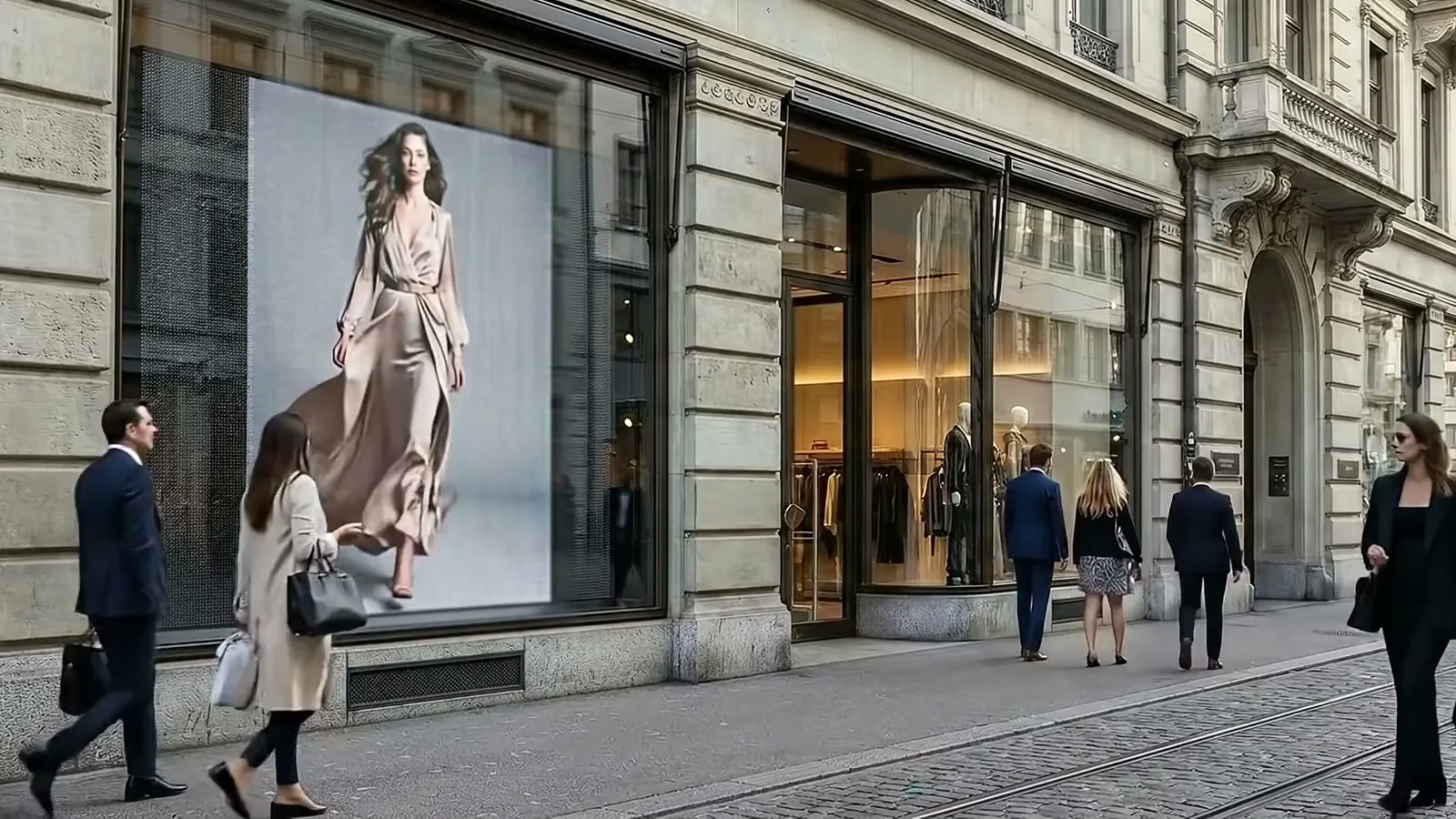
Live across Switzerland & Europe
EN · FR · DE

LED · HYPERVISUAL Switzerland

LED screens and totems for your shop window, readable in full sun.

One bright surface behind the glass, sized for the window you already have and for the street it faces. Sold, installed and maintained in Switzerland.

What it looks like in a window.

Boutiques, practices, agencies and branches: one screen behind the glass, sized for the window and for the light that hits it.

No project in this category yet.

Size your window.

Choose the screen you have in mind: set its area with the slider, type its width and height, or pull its corner. It snaps to real panels of 640 × 480 mm, and the shop front grows around it.

Screen size

Type a size in metres, for example 2 × 3: it snaps to whole panels.

Format
Sun on the glass
People stand
Your window screen, front viewFront view of a shop front with an LED screen of 2.56 × 1.44 m behind the glass, beside a person of 1.75 m.
Front view to scale: the screen in panels of 640 × 480 mm behind the glass, and a passer-by of 1.75 m. Pull the cyan corner to change the size; once it has focus, the arrow keys add or remove a column or a row.

Your window screenSale

2.56 × 1.44 m3.7 m², 12 panels (4 × 3) of 640 × 480 mm, in 16:9

Pixel pitch
P1.86Our usual choice: 1.86 mm between two points of light, sharp from the pavement.
Resolution
1’376 × 774 px344 × 258 px per panel, at P1.86.
Brightness
4’000 nitsSet for the sun on your glass, dimmed at night by a light sensor.
Power
About 1.1 kWOn average (about 300 W per m²); up to about 4.4 kW at full brightness on a white screen.
Request a quote for this screen

An indicative plan in real panels: the stand, the reveal around the screen and the brightness are set with you, on site if necessary. Window screens are sold, installed and maintained, not rented.

Bright by day, dimmed at night.

3’000 to 5’000 nits, with a light sensor

A screen behind glass fights the sky, not a dark room. An indoor wall runs at 600 to 1’000 nits; a window screen runs at three to five times that, so the picture holds when the sun is on the glass. A light sensor follows the street, so the screen drops to a fraction of its output after closing time: easier on the eyes of the neighbours, easier on the LEDs, and a lower bill.
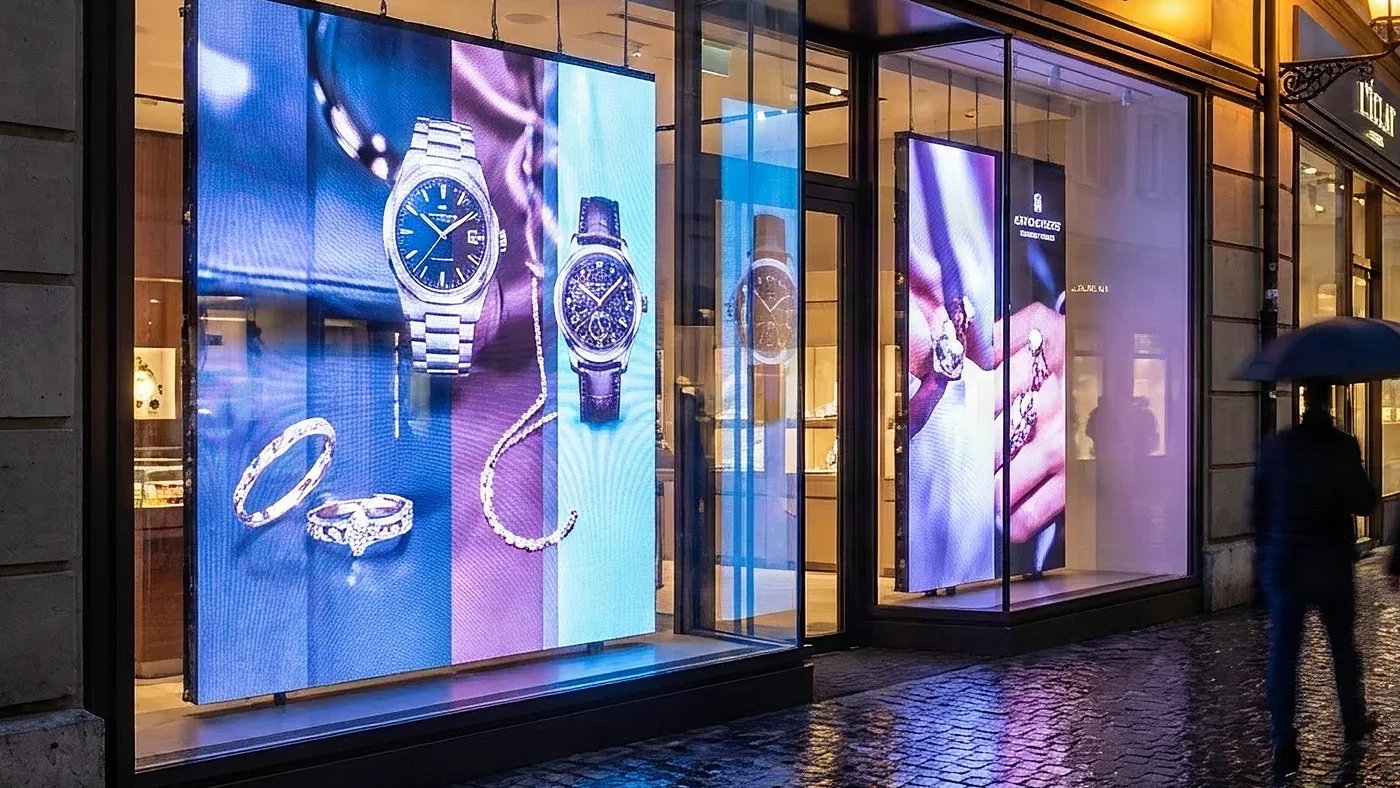
Lit shop windows on a street at dusk, the screens holding their picture against the light of the street

The window sets the size.

Panels of 640 × 480 mm, P1.5 to P1.9

Panels add up in both directions, so the screen is cut to the glass you already have: a full-width wall in a wide shop front, a portrait totem in a narrow one. The pitch is chosen for the pavement: people read a shop window from two to five metres, which puts most windows at P1.5 to P1.9, fine enough that no matrix shows through the glass.
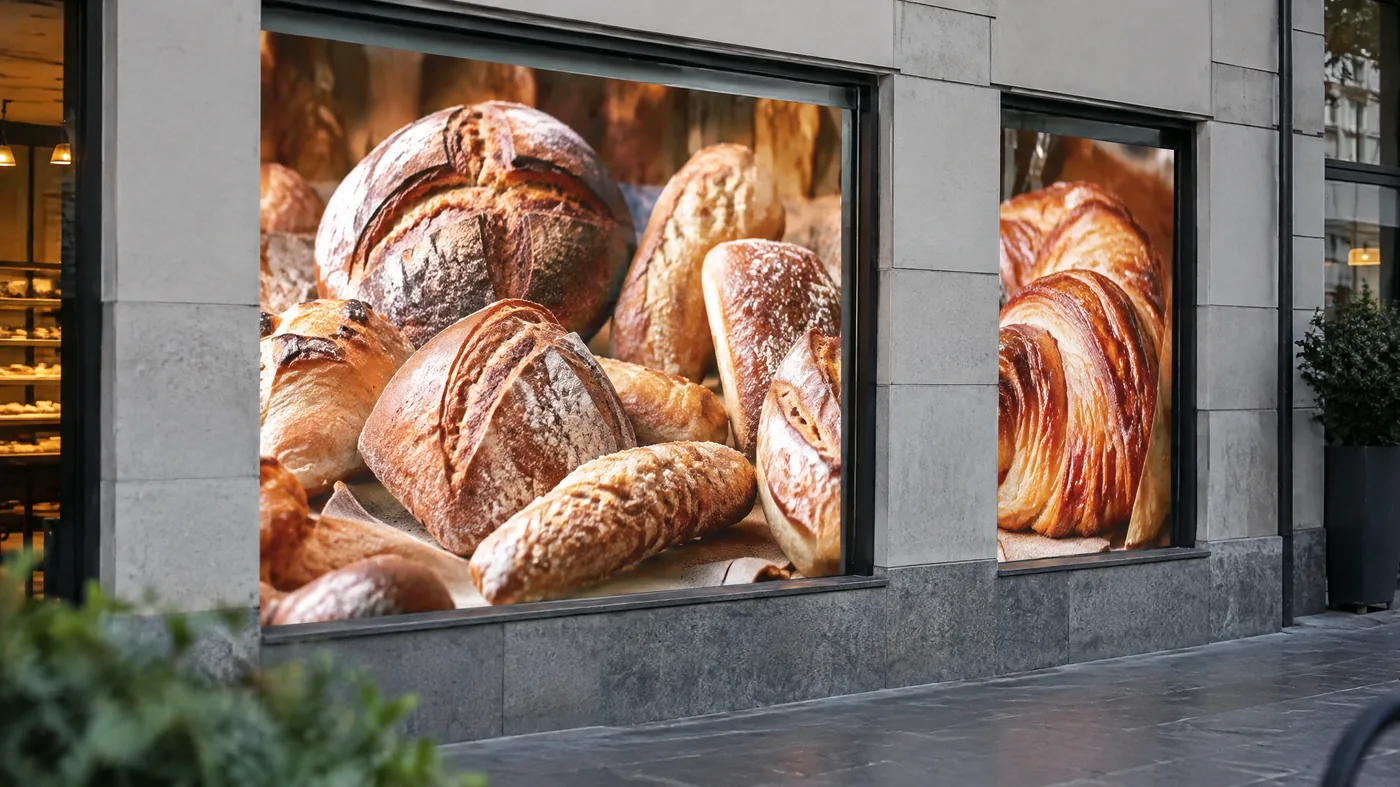
Two shop windows of different sizes, each filled edge to edge by its own LED wall

No need to empty the window.

Magnetic panels, closed back

A window screen is single-sided: the back is closed, so the shop keeps a clean wall behind it and the heat goes where we plan it. Panels come out one by one, magnetically, from inside the shop, so a repair does not mean dismantling the display or closing the front of the store.
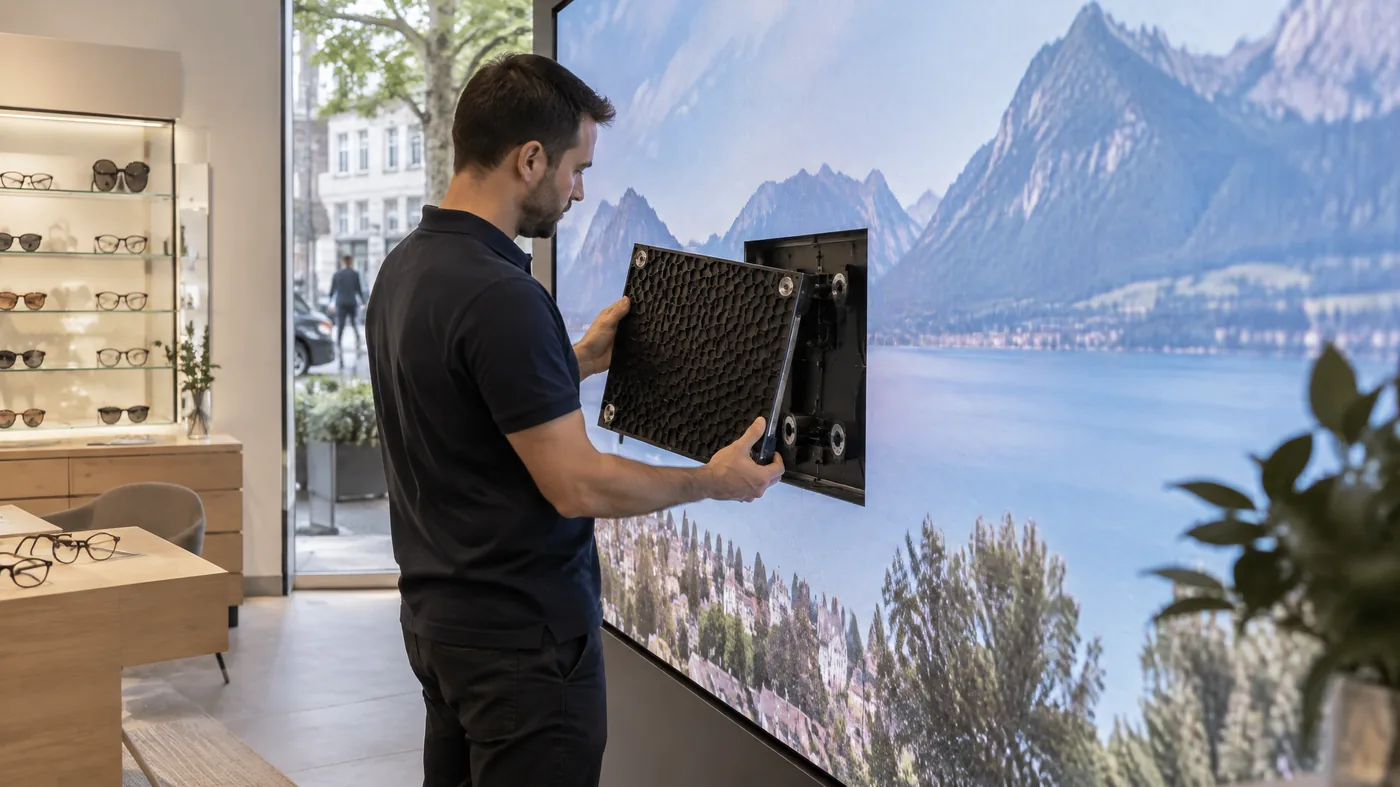
A technician inside the shop holding one LED module pulled from the back of the window wall, the rest still lit

One LED team. Six steps.

  1. Line illustration: in a shopping mall atrium, the future screen is outlined in dashes on the wall above a shop entrance, a technician measures it with a laser meter while the client holds a tablet showing the project01
    SurveySun on the glass, sightlines from the pavement, depth behind the window, power and network: from your plans, on site if necessary.
  2. Line illustration: the design studio of the integrator, two people at a desk with monitors showing the panel layout of a giant LED wall, printed elevations on the wall, an LED panel, a video processor and an equipment rack02
    DesignPanel layout, frame, floor stand or suspension, cable routes, a written proposal.
  3. Line illustration: the reception hall as a work site, a scissor lift in front of the wall, a technician fixing the panel, half the structure already covered, flight case and toolbox on the floor03
    InstallOur own crew, our own tools, on your dates: panels set behind the glass, aligned flush.
  4. Line illustration: a showroom in the evening, the display lit on the back wall, a technician on a flight case with a laptop and a colour probe on a tripod04
    CalibrateEvery panel addressed, brightness set for the street and for the night, seams checked.
  5. Line illustration: a hotel lobby with a giant screen lit on the back wall, a technician handing the control tablet to the client, guests with suitcases watching05
    OperateSources tested, your team shown the controls. Your own sources, or DATAVSN.
  6. Line illustration: the hotel lobby, one panel removed from the giant screen and held by a technician on a stepladder, a colleague with a laptop plugged into the wall, an open case of spare panels and tools06
    CareSpare panels held, and the same crew that installed the screen.

No subcontractor between you and the window. The people who size your screen are the people who switch it on, across Switzerland and into Europe.

Before we come

What the site needs

  • A window reveal deep enough for the screen and its air gap
  • A dedicated power supply and a network point at the screen
  • Joinery and integration around the screen
  • Access to the shop front on the day
One team

Who does what

HYPERVISUAL
Survey, supply, structure, installation, calibration, commissioning, maintenance.
You or your contractor
Joinery, cladding, upstream electrics and network.
Together
The technical check, on site if necessary, the schedule around your shop hours, and the content that goes on the screen.

Buy it, then decide what runs on it.

Sale

Buy

Survey, supply, installation, commissioning. A window screen is sized for the glass and for the light that hits it, drawn with your fit-out contractor, and mounted behind the window on a stand, a suspension or a frame. Sold, not rented: it stays on the shop front. For a date: event LED walls.

Plan an installation LED screen sales
Software, optional

Run

DATAVSN, our own CMS, if you want it. Never imposed. The screen takes your own sources just as well: a computer, a player, a signal chain you already own. DATAVSN adds scheduling, and the audience metrics if you want them.

See DATAVSN Custom software

What makes the price.

We do not publish a tariff: every window is quoted on a brief, because no two shop fronts face the light the same way. Six things move the figure.

Written offer, line by lineWindow LED screen
  1. The surface and the formatSquare metres first, then the shape the glass allows: full width, portrait totem, or a band above the display.
    per m²
  2. The pixel pitch, so the reading distanceFrom the pavement, most windows sit at P1.5 to P1.9; closer to the glass, finer.
    per pitch
  3. Brightness and the glass it sits behindHow much sun the window takes, and the cooling and the air gap that go with it.
    per exposure
  4. The build: stand, frame, access for serviceThe floor stand or suspension, the reveal around the screen and the room left to open it.
    per site
  5. The content and how the wall is runYour own sources, or DATAVSN, our CMS hosted in Switzerland.
    optional
  6. Maintenance and the spare panels held for youWhat keeps the picture on, year after year, without emptying the window.
    per year

How we quote. You describe the shop front, we visit the site if necessary, and we come back with a written offer: panels, structure, mounting, installation, commissioning and maintenance, line by line.

TotalOn your brief

Datasheet.

A window screen is a permanent installation, built from fixed-install panels and run far brighter than an indoor wall. What follows is what we fit most often behind glass.

Elevation of a window LED screen built from 640 by 480 millimetre panels A screen of four panels by three, 2.56 metres by 1.44 metres, drawn to scale beside a person of 1.75 metres. One panel is dimensioned. 1.75 m P1.86 640 mm 480 mm 2.56 m · 4 panels 1.44 m 3 panels
One panel of 640 × 480 mm, and a screen of four by three. The surface is decided by the glass, not by a screen size.
Panel
640 × 480 mm
Fixed-install, single-sided, closed back. Rental panels are a different product.
Pixel pitch
P1.5 to P1.9
Read from the pavement, two to five metres away. P1.86 is our usual choice.
Resolution
344 × 258 px
Per panel at P1.86, and it adds up with the panels.
Brightness
3’000 – 5’000 nits
Three to five times an indoor wall, with a light sensor that drops it at night.
Power
~300 W/m²
On average; up to about 1’200 W/m² at full brightness, white screen.
Content
DATAVSN
Or your own sources. Our CMS is hosted in Switzerland.
UseBehind the glass, permanent, sale. For a date: event LED walls.
ShapesFull width, portrait totem, or a band above the display.
MountingFloor stand, suspended, wall-mounted or recessed.

Window LED on DATAVSN.

Our own CMS, hosted in Switzerland. It is available with every window screen we sell and it is never imposed: a computer, a player or a signal chain you already own drives the screen just as well.

  1. Content and scheduling

    Publish, schedule and update your screens from one place. The base of every DATAVSN installation.

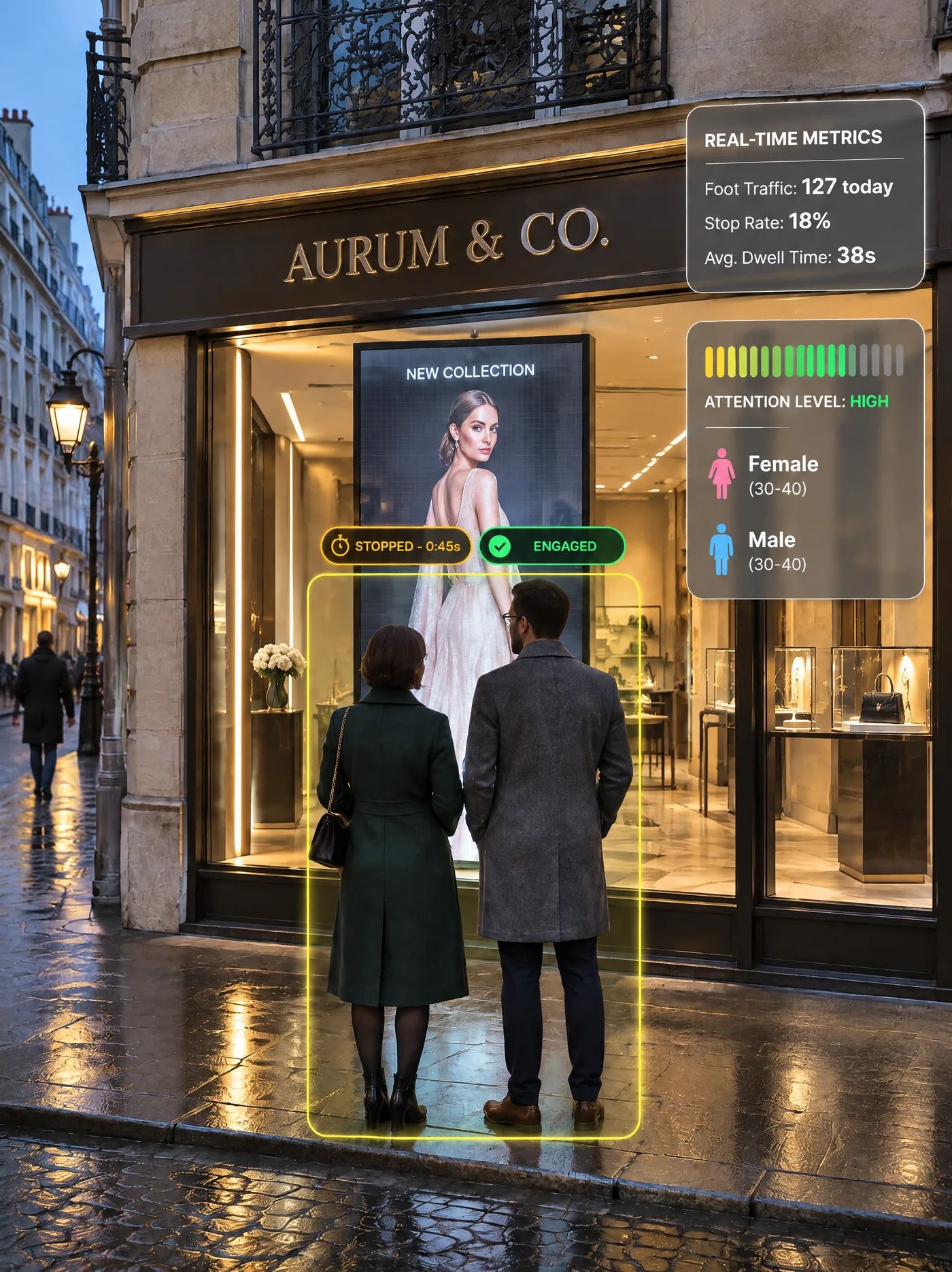
  2. Anonymous audience recognition

    Foot traffic, stop rate, dwell time, attention time, age and gender brackets. Metrics only: no face is recognised.

  3. Interactivity

    Touch, sensors and live data when the window has to respond, not just display.

A portrait LED screen in a shop window at dusk, watched by two people, with the DATAVSN audience metrics shown over the shopfront
Anonymous audience recognition. DATAVSN collects the metrics, never the people: foot traffic, stop rate, dwell time, attention time, age and gender brackets. No face is recognised.

Your questions.
Answered straight.

Anything specific to your shop front is settled when we size the screen.

How bright does a screen behind a shop window need to be?

Three to five times an indoor wall. An indoor LED wall runs at 600 to 1’000 nits; behind glass you start at 3’000 and go to 4’000 or 5’000 when the sun reaches the window. A light sensor then drops the output after closing time, which spares the neighbours, the LEDs and the bill.

Will it still be readable in direct sun?

Yes, if it is specified for it. What kills a window screen is rarely brightness alone: it is the reflection of the street on the glass. We look at which way the window faces and at the hours the sun is on it, then set the brightness and the position behind the glass accordingly.

Does it overheat behind the glass?

Not when it is built for the job. A window screen is single-sided with a closed back and active cooling, and we leave an air path between the glass and the panels. Budget about 300 W/m² on average, up to roughly 1’200 W/m² on a white screen at full brightness.

Which pixel pitch do I need for a shop window?

People read a shop window from two to five metres, which puts most of them at P1.5 to P1.9; P1.86 is our usual choice. Finer pitches only pay off when the screen sits right against the glass and people stand at arm's length from it.

Can it be a portrait totem instead of a full window?

Yes, and it is the same product: the panels are 640 × 480 mm and add up in both directions. A narrow shop front takes a portrait screen on a floor stand or suspended from the ceiling; a wide one takes a screen the width of the glass.

Do you rent window screens?

No. A window screen is a permanent installation, sold, installed and maintained. If you need a screen for a date rather than for years, that is what our event LED walls are for, on rental panels.

Window LED screens in Switzerland

Let's talk about
your shop window

Tell us the window. We come back with a written offer for the right screen behind it, sized and priced, not a catalogue.

  1. The window. Its width, its height, and which way it faces.
  2. What it is for. Shop, practice, agency or branch, and what will play on it.
  3. The hours the sun is on it, or simply a photo of the shop front.
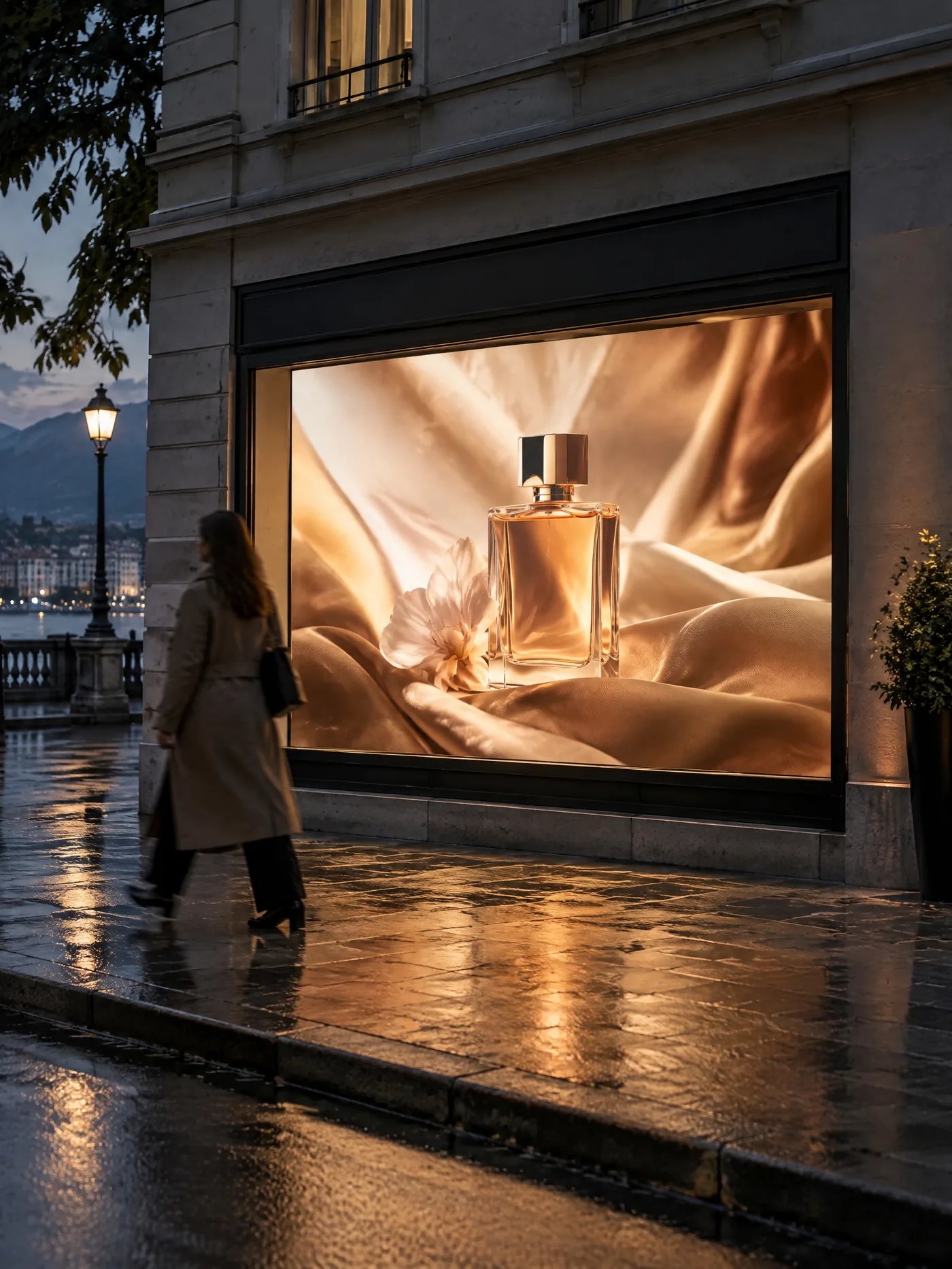
LED wall filling the window of a perfumery at dusk, a passer-by walking past on the wet pavement
Window LED screens, set behind the glass and run bright enough for the street.