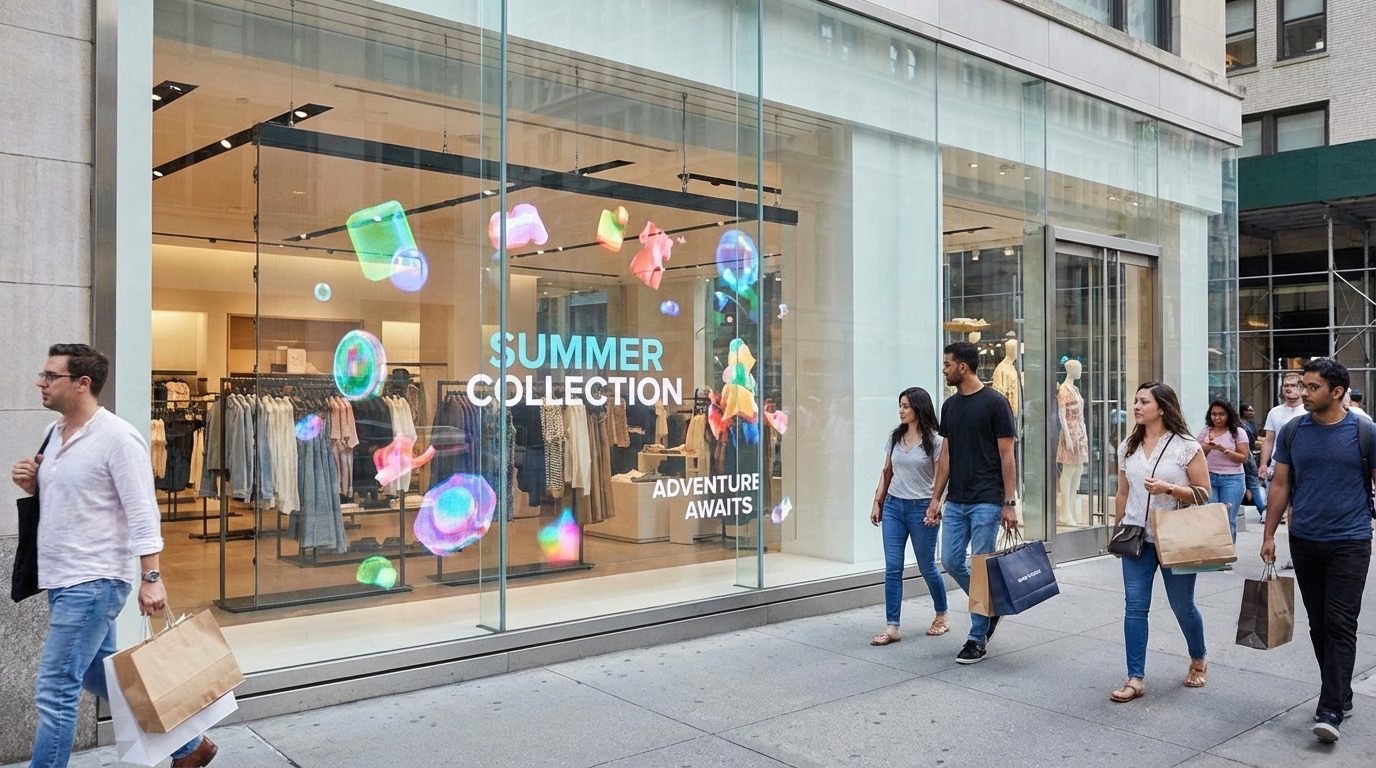
The shop window is the first, and often the only, contact between a store and the people walking past it. This guide explains how a storefront digital display turns that window into a communication channel, how to choose the technology according to sun exposure, what an installation behind glass requires, and how to design content and measure its impact.
On this page
Key takeaways
- A digital display turns the shop window into a prime advertising space that adapts to the time of day and is updated within minutes, in one store or across a network
- Technology follows sun exposure and reading distance: high-brightness LCD for most windows, LED for large formats, transparent LED for luxury windows
- Behind glass, a display lives in a greenhouse: thermal management and hardware rated for high temperatures are essential
- A passer-by gives the window only a few seconds: one bold message, motion, high contrast, short loops and automatic night dimming
According to Grand View Research (June 2026), the global Digital Signage market, valued at USD 31.1 billion in 2025, is projected to reach USD 58.4 billion by 2033, a compound annual growth rate (CAGR) of 8.2% from 2026 to 2033.
Why storefront digital displays outperform static signage
Traditional printed displays face structural limitations: they show one message to everyone, at every hour, in every weather, and every change costs printing, logistics and installation time. Digital storefront screens remove these constraints and add capabilities print cannot match.
Dynamic content scheduling: morning commuters, lunchtime shoppers and evening strollers see different messages. Content can follow the weather, local events or stock levels: a rainy afternoon promotes umbrellas, a heatwave pushes the summer collection.
Instant updates: a flash sale, a price change or a sold-out product is reflected on the window within minutes, across one store or a whole network, with no printing and no waste.
Day and night presence: the window keeps selling after closing time. Evening passers-by are tomorrow’s customers: a schedule of ambient brand content with adapted brightness works for them while the store sleeps.
Measurable attention: with DATAVSN, the software developed by HYPERVISUAL and hosted in Switzerland, anonymous audience recognition can be added as an option. It provides three metrics for the window (anonymous counting, stop rate, dwell time) without identifying anyone, so you can compare content variants and identify peak periods.
Choosing the right storefront display technology
Not every storefront requires the same solution. The choice follows three questions: how much direct sun hits the glass, how far do people read from, and how much of the window may be covered?
High-brightness LCD displays: the workhorse for most windows. A standard indoor screen is washed out behind sunlit glass: HYPERVISUAL’s window displays range from 1’000 to 5’000 nits, and south-facing windows call for 2’500 nits or more. Slim profiles and portrait orientation suit most retail glass.
Direct-view LED screens: for large formats and maximum brightness. Beyond a certain size, a window screen is no longer a single LCD but an LED screen built from panels. Pixel pitch follows reading distance; as a rule of thumb, allow about one metre of viewing distance per millimetre of pitch. On the market, fine pitches around P2.5–P4 serve close pedestrian viewing, and wider pitches suit a screen read from across the street.
Transparent LED: the luxury option. The screen shows content while the products and the store interior remain visible behind it, for impact without sacrificing natural light or the view into the shop. Our guide to transparent LED displays explains the two formats used on shop windows.
For event and exhibition applications, see our guide on trade show LED walls.
Technical requirements that make or break a window installation
Brightness and ambient light: plan a minimum of 2’500 nits for south-facing glass; an ambient light sensor adjusts brightness automatically and prevents the screen from glaring at night. Our guide to display brightness in nits and lumens explains how these values are measured.
Thermal management: behind glass, a display lives in a greenhouse. Direct sun can push temperatures beyond 50 °C, so choose hardware rated for it and plan ventilation or extraction in the window bay.
Viewing angle: pedestrians approach from the side, not head-on. Panels with 178° horizontal and vertical viewing angles stay readable along the whole pavement.
Continuous operation: shop windows run long hours, often late into the evening. Professional-grade panels are designed for extended daily operation; consumer TVs are not.
Power, access and scheduling: plan power routing in the window bay, service access behind the screen and automatic on/off times, which also help meet municipal rules on night-time illuminated advertising where they apply.
Content strategies that convert
Bold, simple messaging: a pedestrian gives the window only a few seconds. One message, large type, strong contrast: details belong inside the store.
Motion attracts, rhythm retains: movement draws the eye far better than a static visual, but keep loops short and legible; a window is not a cinema.
Day and night versions: daylight content fights the sun with brightness and contrast; evening content lowers the intensity and favours atmosphere.
A bridge to action: QR codes linking to a promotion, a booking page or the online store turn attention into a measurable next step.
Measuring storefront display impact
Set the baseline before installation: entries per day, sales of the products to be featured. Then compare store entries before and after deployment, dwell time in front of the window measured anonymously, and redemptions of window-specific QR codes or promo codes. Review monthly and let the results decide which content earns the window.
HYPERVISUAL storefront digital display solutions
HYPERVISUAL designs turnkey storefront display solutions for Swiss and European retailers: technology matched to your window’s exposure, installation, content scheduling and maintenance. We visit the site if necessary, and we come back with a written offer.