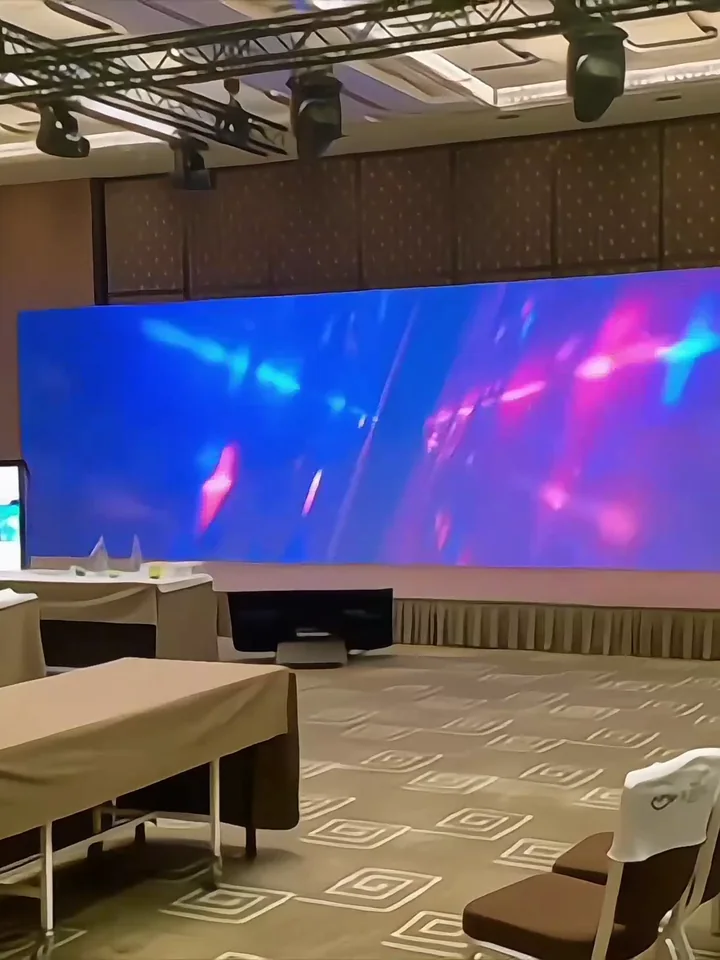
A trade show LED wall pays off when it is sized to the stand, no brighter than the hall requires, fast enough for cameras and fed with content made for it. The six tips below cover these points, the choice between rental and purchase, and how to measure the return over two shows.
On this page
Key takeaways
- Stand size drives the specification: a compact screen for a 3 × 3 m stand, a larger wall for 3 × 6 m, and from 6 × 6 m a wall designed as part of the stand’s architecture
- Indoor exhibition halls need moderate brightness (roughly 800–1’500 nits): over-bright walls wash out on camera and tire visitors at close range
- A refresh rate of at least 3’840 Hz is essential: every photo and video shot at your stand depends on it
- Rental fits occasional exhibitors, purchase fits recurring event programmes: the crossover point is your annual show calendar, not the list price
Grand View Research (June 2026 edition) estimates the global Digital Signage market at USD 31.1 billion in 2025 and projects USD 58.4 billion by 2033, a compound annual growth rate (CAGR) of 8.2%.
“A trade show LED wall turns a stand from a backdrop into an experience. But the wall only pays for itself when the content is built for the medium and the stand is designed around it, not the other way round.”
The HYPERVISUAL team
The visual differentiator on the show floor
An exhibition hall is the most competitive visual environment your brand will ever face: hundreds of stands, thousands of visitors walking past in seconds, and a single chance to make someone turn their head. Printed graphics have become background noise in that setting. An LED wall moves, changes and lights up the aisle, which is exactly why it has shifted from luxury addition to standard exhibition tool for serious exhibitors.

1. Why an LED wall outperforms printed graphics
Static panels say one thing for the whole show. An LED wall carries your full argument: product demonstrations for the morning technical crowd, a customer story at midday, a live session or countdown when your presentation starts. It also removes the reprint problem: a last-minute product change, a corrected price or a new partner logo is a file upload, not a courier deadline. And when the show ends, the same panels travel to your next event with different content.
2. Sizing the wall to the stand
The stand footprint determines what works. Common stand sizes of 3 × 3 m, 3 × 6 m and 6 × 6 m each call for a different approach.
Small stands (3 × 3 m): a compact LED screen of roughly 3–4 m², placed as the visual anchor behind the meeting point. Going bigger crowds the space and dazzles visitors standing a metre away.
Medium stands (3 × 6 m): 6–10 m² of LED wall creates a genuine backdrop for demonstrations while leaving room to circulate. This is the format where a wall starts to pull visitors from across the aisle.
Large stands (6 × 6 m and above): the LED wall becomes part of the stand’s architecture, mounted on a structure or on truss if needed, and should be designed with the stand, not added afterwards. We applied the same principle in our case study on ten pop-up stores: the screen dimensions were fixed before the furniture was designed.
3. Technical specifications that matter in a hall
Pixel pitch follows viewing distance. Visitors read your wall from one to ten metres, not from across a stadium. A pitch that is too coarse looks pixelated at the meeting table; a pitch far finer than necessary inflates the budget without visible benefit. Our technical guide to pixel pitch explains how to choose it.
Brightness: moderate, not maximum. Indoor halls are lit for people, not for sunlight: roughly 800–1’500 nits is the working range. An outdoor-grade wall indoors washes out photography and fatigues anyone standing close. Our guide to nits and lumens covers how to match brightness to a venue.
Refresh rate of at least 3’840 Hz. Everything shot at your stand (press photos, sales videos, visitor selfies, your own social content) will show scan lines if the refresh rate is too low. This single specification decides whether your wall photographs well.
Logistics specifications. Panel weight and rigging points, hall power supply and distribution, cable routing that respects safety rules, flight cases for transport, and setup time within your assigned build-up window. Ask about these before signing: they decide whether installation day is calm or chaotic.
4. Content built for the medium
The most common waste on an exhibition floor is a superb wall showing a corporate slide deck. Content for an LED wall follows different rules: no small text (a visitor reads a headline at four metres, not a paragraph), high contrast, motion in the first second, and loops short enough that a passer-by catches a complete idea. Plan a modular playlist: a long-form loop for quiet periods, a short attention loop for peak traffic, and a presentation mode your speakers control. Prepare files at the wall’s native resolution and aspect ratio: a stretched 16:9 video on a non-standard canvas signals improvisation.
5. Rental or purchase?
The decision is driven by your event calendar rather than by unit price. Rental makes sense for occasional exhibitors: no storage, no maintenance, no obsolescence risk, and the format can change from one show to the next. Purchase starts to pay off for organisations with a recurring programme of shows, roadshows and internal events. Two costs are often left out of the comparison: transport with insurance, and the labour of build-up and tear-down. Include both, and the arithmetic becomes honest.
6. Measuring the return
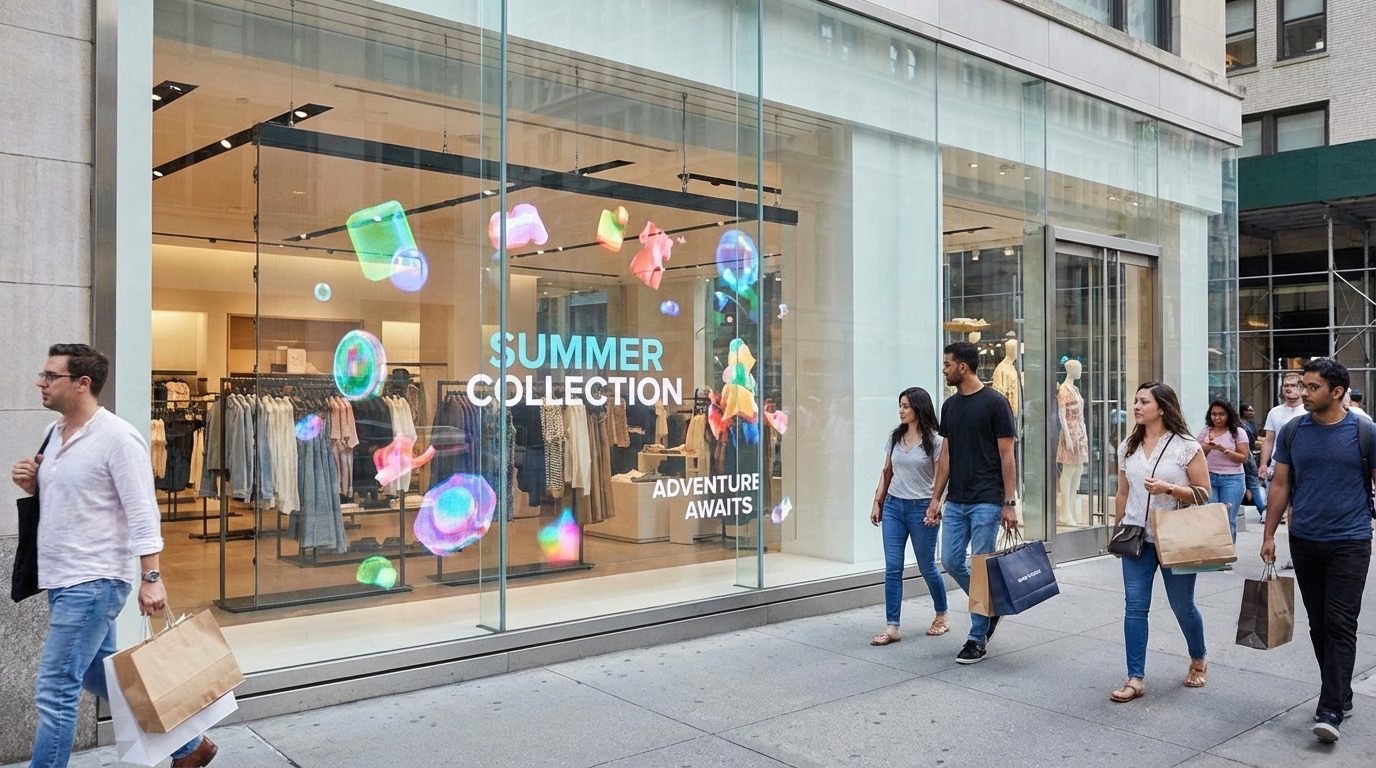
Set the measurement plan before the show, not after. Useful comparisons: qualified leads per show hour versus your previous edition, dwell time at the stand, scans of a wall-specific QR code or promo code, meetings booked from the stand, and press or social media coverage featuring the wall. Then compare the same metrics across two editions: the second show is where an LED wall proves or disproves itself. For year-round applications of the same technology, see our storefront digital display guide.
Renting a trade show LED wall from HYPERVISUAL
HYPERVISUAL provides LED walls for trade shows and events across Switzerland and Europe, from quote to dismantling: sizing to your stand plan, panels matched to the hall, content adapted to the wall and build-up on site. For rental, our walls are built from flat 500 × 1’000 mm panels, mounted on a structure or on truss if needed, for surfaces of up to 30 m² in P2.6 indoors.