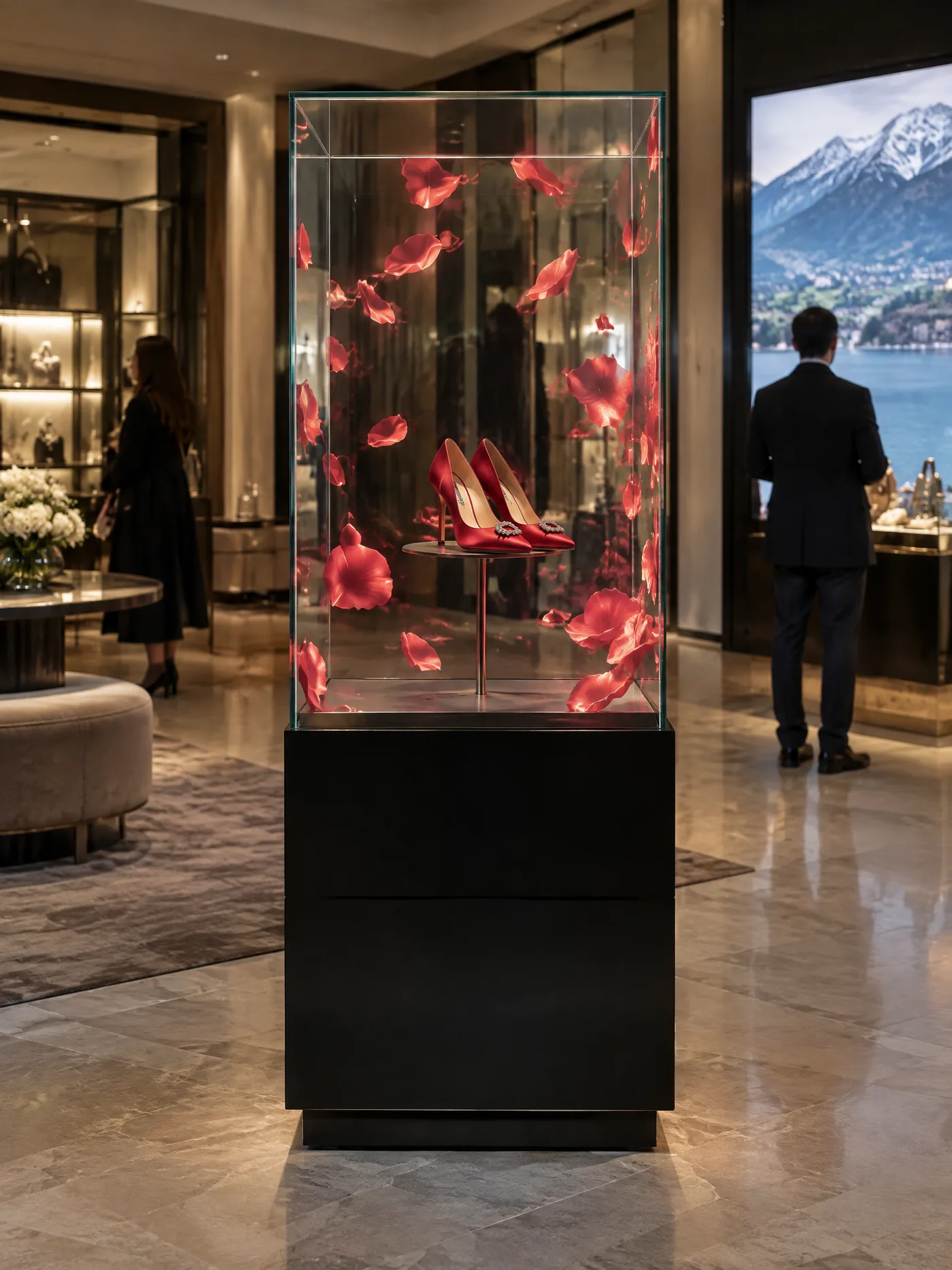
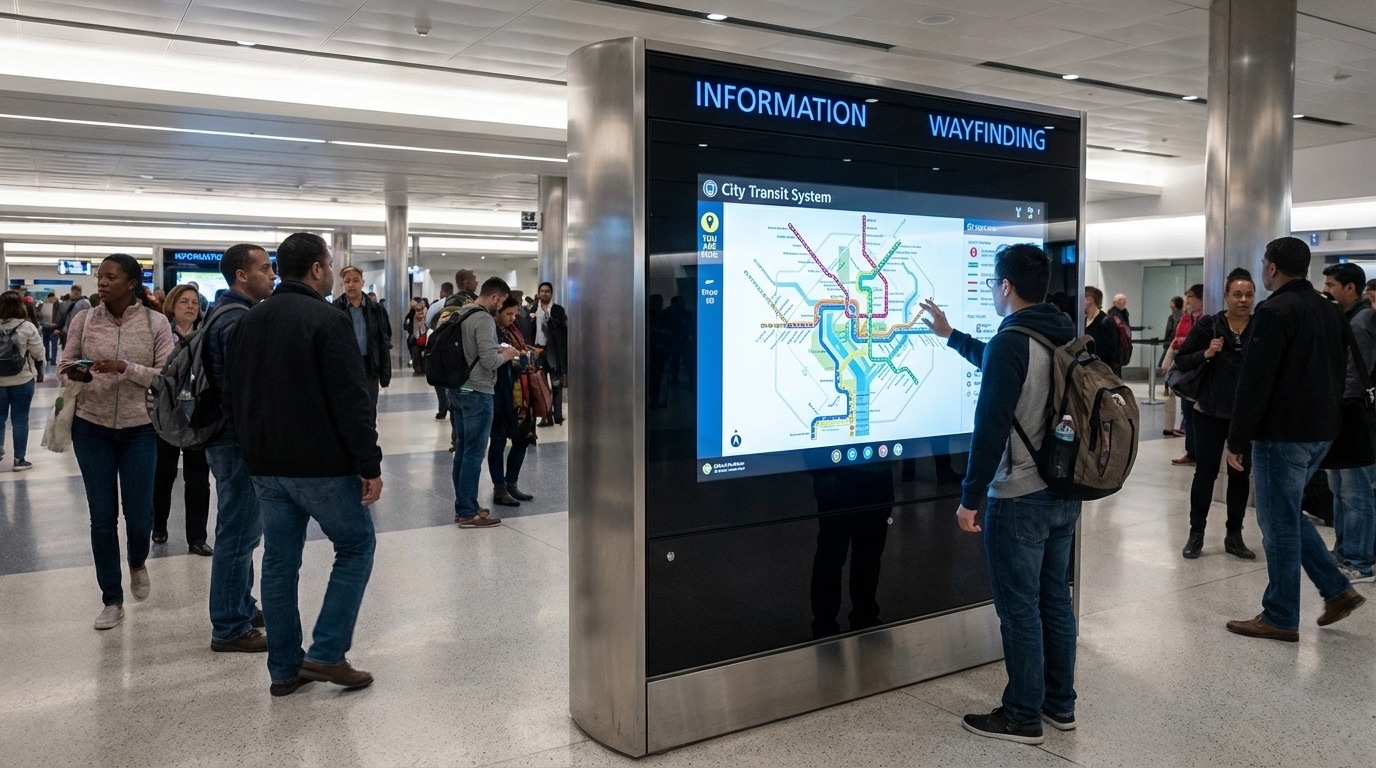
This design study describes how HYPERVISUAL proposed to equip ten identical pop-up stores in Switzerland: a 32″ portrait screen whose dimensions were fixed before the furniture was designed, a 4G-connected fleet managed from a single CMS, and optional anonymous audience recognition with DATAVSN. It shows why, on a multi-site integration project, the order of decisions matters more than the choice of brands.
On this page
Key takeaways
- Ten identical pop-up stores to equip simultaneously across Switzerland, one 32″ portrait screen per site: a homogeneous fleet managed from a single point
- The key decision of the project: freeze the screen dimensions first, and let the furniture makers design their structures around them, the reverse of the classic trap
- High-brightness 1’000-nit panels with an ambient light sensor: readable in a shopping centre, without glare at the end of the day
- Fanless industrial Android player with built-in 4G LTE: no dependence on the host venue’s network
- Remote fleet management in the client’s CMS: player status, reboots, OTA updates and diagnostics without travelling to the site
- Optional anonymous audience recognition with DATAVSN: the same hardware, activated by software, to know which audience the campaign actually reaches, not just how many people
- Compliance designed upstream: the FADP, the European AI Act and sector-specific regulation documented in a legal note delivered with the proposal
Design study: project carried out for an international brand in the tobacco sector, as part of the rollout of a network of temporary trial spaces in Switzerland. The client is not named. This study documents the design and pre-project phase.
The brief: ten locations, one brand image
The client is preparing to launch a network of ten identical pop-up stores in Swiss shopping centres and kiosks. Each space integrates a vertical screen into furniture developed by a design office. The planned operating period is two to three months per site, with the possibility of making it permanent. The screens and players are offered for sale, not for rent.
Three constraints structure the project. Consistency first: ten sites, a single campaign, a single management interface; the client’s marketing team must be able to programme the entire fleet without depending on anyone. Autonomy next: the locations are rented for a few weeks, so relying on each shopping centre’s IT network is out of the question. Integration finally: the screen disappears into the furniture rather than sitting on top of it.
One decision simplified everything: the screen before the furniture
On furniture projects that integrate a display, the failure scenario is always the same: the furniture is designed, produced, delivered, and the screen chosen afterwards does not fit, or leaves unsightly gaps that betray the assembly.
We proposed the reverse approach. The exact dimensions of the panel (overall frame, visible area, thickness) were frozen first, based on a custom-built 32″ portrait open frame display. These dimensions were then passed on to the design office, and the client’s furniture tender now requires manufacturers to design their structures around the screen.
An open frame display is a professional monitor delivered without housing, designed precisely to be built in. Combined with this reversal of the process, the solution enables a perfectly flush fit in all ten furniture units, whichever manufacturer is selected.
The technical architecture
Brightness driven by the environment
A shopping centre is a changing light environment: skylights, retail lighting, neighbouring shop windows. The selected panels deliver 1’000 nits (roughly three times a consumer display) and embed an ambient light sensor that continuously adjusts the intensity. The image remains readable at peak hours and stops dazzling when the environment darkens, which also reduces power consumption and preserves panel lifespan.
An industrial player, not a media stick
Each screen is driven by a fanless industrial Android player in a machined aluminium housing, built for continuous operation. The decisive choice: the 4G LTE module is natively integrated into the player. Each site is connected independently from the moment it is installed: no network access negotiations with ten different shopping centre operators, no cabling to pull in a space rented for eight weeks.
Ten screens, one console
The entire fleet is managed from a central CMS: campaign creation, scheduling per site or across the whole network, playback control. The client produces its content in-house; the platform distributes it and verifies playback. The client’s team also manages the fleet from the same interface: status of every player, remote reboots, OTA updates, diagnostics without travel. On a temporary multi-site network, every avoided physical intervention counts double.
A stock of spare parts (screens, players, cameras) is kept at our premises in Fribourg: in the event of a failure, the unit is replaced, not repaired on site.
The second question: which audience is really watching?
A screen network answers the question “is the message playing?”. The next question is of far more interest to a marketing department: which audience does the message reach, site by site?
That is the subject of the second part of the proposal: the same installation, completed with a wide-angle USB camera and a software activation of DATAVSN, adds anonymous audience recognition for each site: anonymous counting, stop rate, dwell time, distribution by gender and age range, and peak hours. Enough to compare the ten locations with one another, adjust content to real visiting hours, and document the campaign’s performance with measurements rather than impressions.
The architectural principle: all processing happens locally, on the player, at the edge. No image is stored or transmitted: the camera feed is analysed on the fly and destroyed after a few tens of milliseconds; only anonymous statistical counters are kept. No facial recognition. No emotion detection either: it was ruled out from the start, because its scientific basis is disputed and it would add nothing to audience measurement. The system’s measurements are limited to anonymous counting, stop rate, dwell time, gender and age range; their assessment under the FADP and the AI Act is set out in the legal note delivered with the proposal. Information signage is planned near each screen.
Compliance as a deliverable, not a checkbox
The proposal delivered to the client includes a dedicated legal compliance note covering the Swiss Federal Act on Data Protection (FADP), the European AI Act and the sector-specific regulation applicable to the client. For an international brand operating in a regulated sector, this annex is not an add-on: it is often what allows the project to pass the compliance department’s review. Our case study of a conversational holographic avatar for a Swiss university follows the same principle: the legal assessment is part of the project from the start.
What this project shows
Three convictions. First, on an integration project, the order of decisions matters more than the choice of brands: freezing the screen before the furniture eliminated the project’s main risk. Second, a temporary network should be designed as a fleet: native 4G, central management and spare parts turn ten scattered sites into a single system. Third, anonymous audience recognition is decided at the architecture level: edge processing with no image storage is what keeps the measurement anonymous.