This design study documents the framing phase of a conversational holographic avatar for the entrance hall of a Swiss public university (the institution is not named). It explains the architecture (real-time 3D rendering, a language model hosted in Switzerland with a local fallback), the legal assessment carried out before the offer, and how the institution keeps the avatar’s knowledge up to date itself.
On this page
Key takeaways
- A conversational holographic avatar for the public entrance hall of a Swiss university: welcome, wayfinding and campus information throughout opening hours
- Photorealistic real-time 3D rendering and natural voice dialogue, backed by a knowledge base specific to the institution
- Data sovereignty as a design requirement: the language model is hosted in Switzerland, with a local on-site fallback in case of unavailability
- No personal data stored: no facial recognition, no visitor profiles, no history linked to a name
- The legal assessment preceded the offer: a full compliance analysis covering cantonal data protection law, the FADP, the European AI Act and image rights for appearance and voice cloning
- A knowledge base the institution can edit itself after training: the content lives on without depending on the integrator
The brief: a front desk that talks, in a public institution
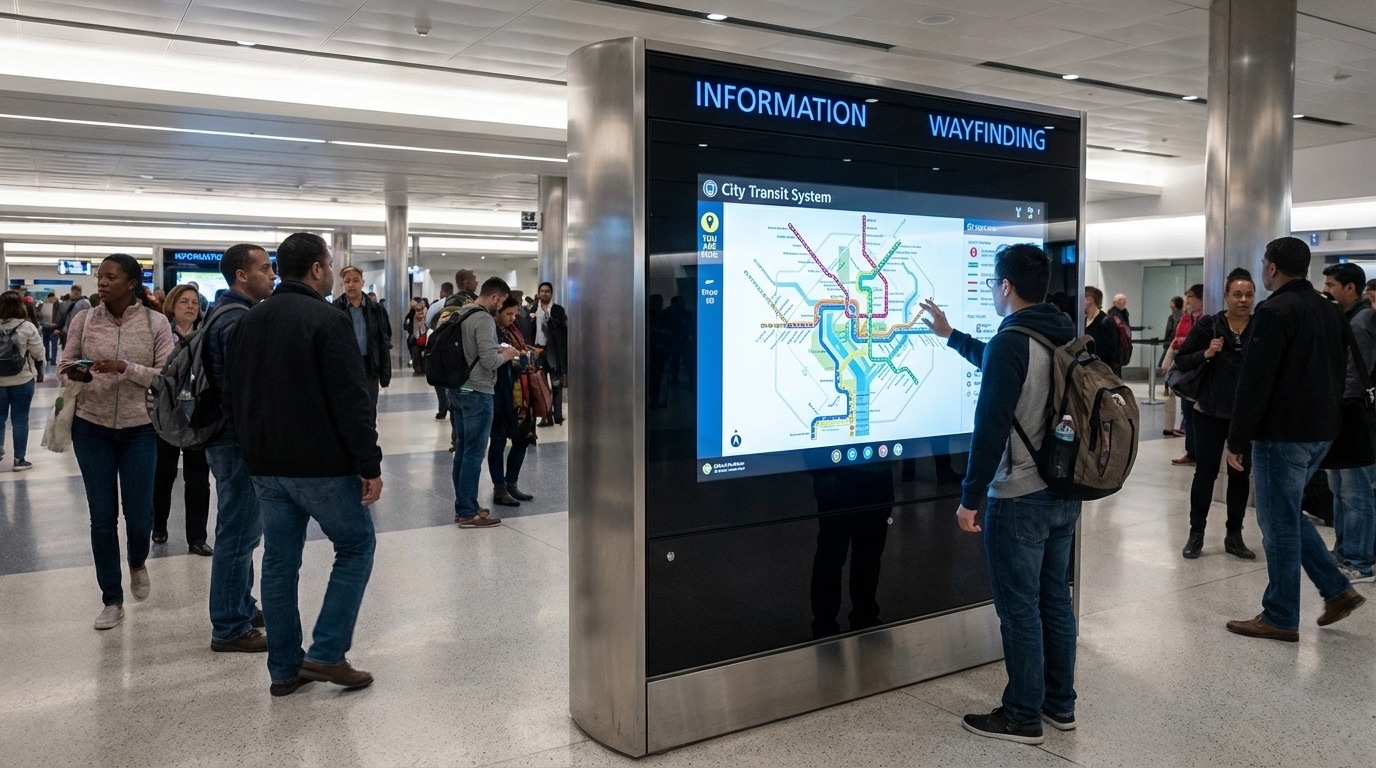
The entrance hall of a campus sees thousands of people pass through: students, visitors, applicants, external speakers. The questions are recurrent (where a given room is, how to register for an event, what the opening hours of a service are), and at peak times their volume saturates the human front desk, which must remain available for complex requests.
The institution wanted a complementary reception device: visible, engaging, available throughout opening hours, able to answer practical campus questions in natural language. As a Swiss public institution, it also had two non-negotiable constraints: compliance with cantonal data protection law and the FADP, and an acquisition procedure that respects public procurement law.
The choice: a conversational holographic avatar
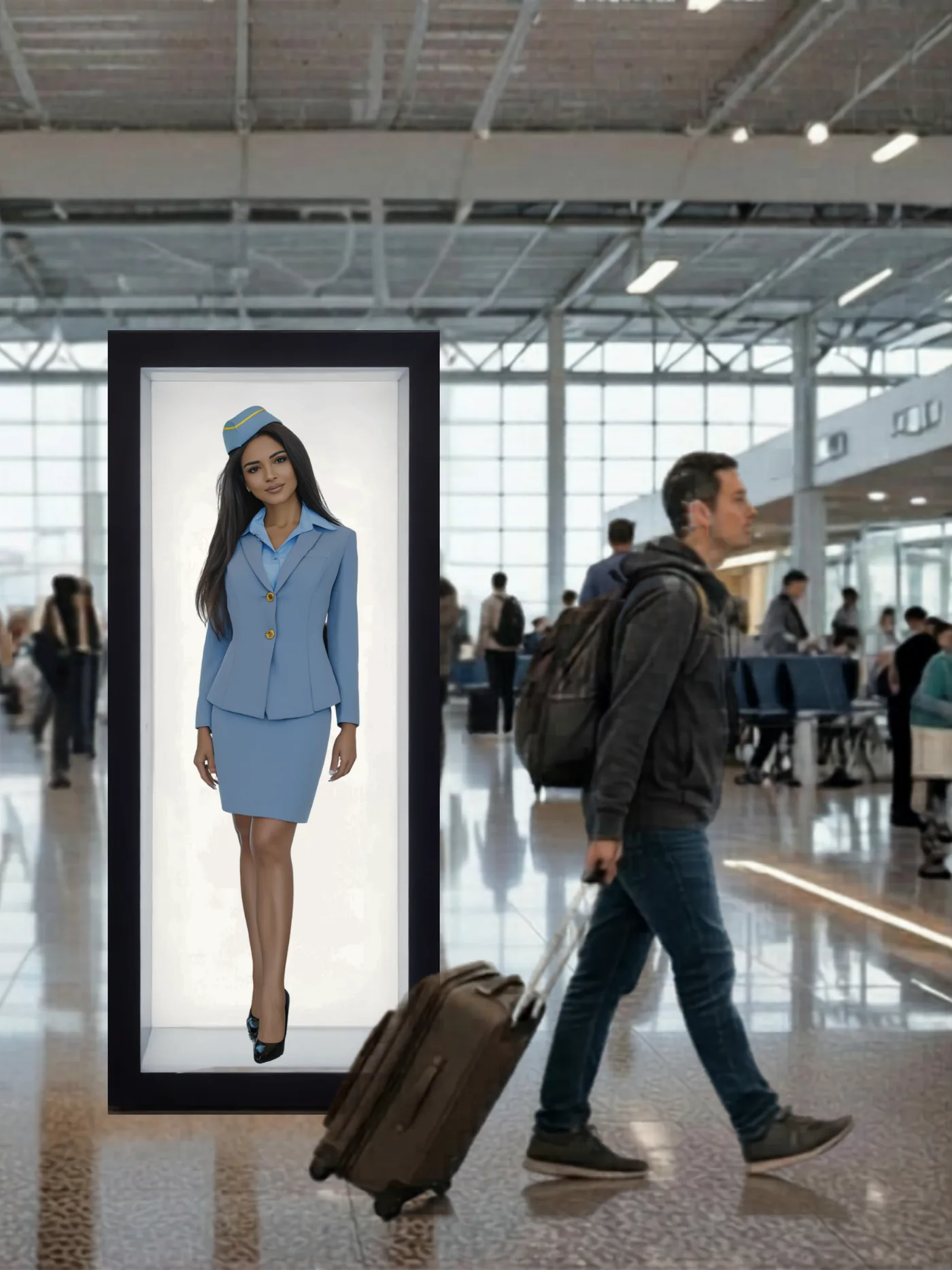
The solution we designed is a photorealistic 3D avatar presented in a HoloBox Nova holographic display, animated in real time and equipped with a natural voice. The visitor approaches, asks a question out loud, the avatar answers, and the exchange can continue, because the system holds a conversation, not a fixed list of questions and answers.
Three building blocks carry the experience. Rendering: a digital human animated by a real-time 3D engine, whose quality of presence makes the difference between a gimmick and a credible reception device. Understanding: a language model that interprets the question, reformulates it and builds the answer. Knowledge: a document base specific to the campus (maps, schedules, procedures, service FAQs) that anchors every answer in the institution’s reality rather than in the model’s general knowledge.
Sovereignty as architecture, not as a slogan
For a Swiss public institution, the question “where are visitors’ words processed?” is decisive. The chosen architecture answers it on two levels: the main language model is operated by a Swiss host, on Swiss territory; and a fallback model runs locally, on the device’s own computer, to keep the service running if the main model becomes unavailable. No dependence on a non-European cloud for the conversational core.
On the personal data side, the principle is avoidance rather than after-the-fact protection: the device stores no data that identifies visitors, performs no facial recognition, builds no visitor profile. Exchanges are used only for the duration of the conversation, then disappear.
Legal first: the method that structured the project
On a conversational AI deployment in a public space, the classic mistake is to treat compliance at the end of the project, when the architecture is already frozen. We did the opposite: a full legal audit was carried out before the commercial offer was even written. Our case study of a network of ten pop-up stores follows the same principle.
This audit covers the cantonal data protection law applicable to the institution, the federal FADP (with HYPERVISUAL acting as a processor), the European AI Act, and a specific chapter on appearance and voice cloning: when an avatar takes on the features or voice of a real person, image rights and consent are documented contractually, not verbally. The data protection impact assessment (DPIA) was identified as mandatory and integrated into the project plan, as was the information signage for visitors.
For the acquisition, the public procurement framework was also checked upstream, to establish which award procedure applies: a check that spares the institution an unpleasant procedural surprise along the way.
A knowledge base that lives without us
The value of a reception agent lies in the freshness of what it knows. The initial knowledge base is built by us from the institution’s documents (service FAQs, practical information, reception procedures), then handed over to the campus team with dedicated training and user documentation. The institution then enriches its base autonomously through the management interface: an event added, a schedule changed, and the avatar knows it.
What this project shows
Three convictions. First, conversational AI in a public space is above all a compliance project: the legal-then-technical order is not excessive caution, it is what makes deployment possible in a public institution. Second, sovereignty is decided at the architecture level: Swiss hosting and local fallback cannot be grafted on afterwards. Third, a reception avatar only has value if the institution can feed it itself: training and client autonomy are part of the product.