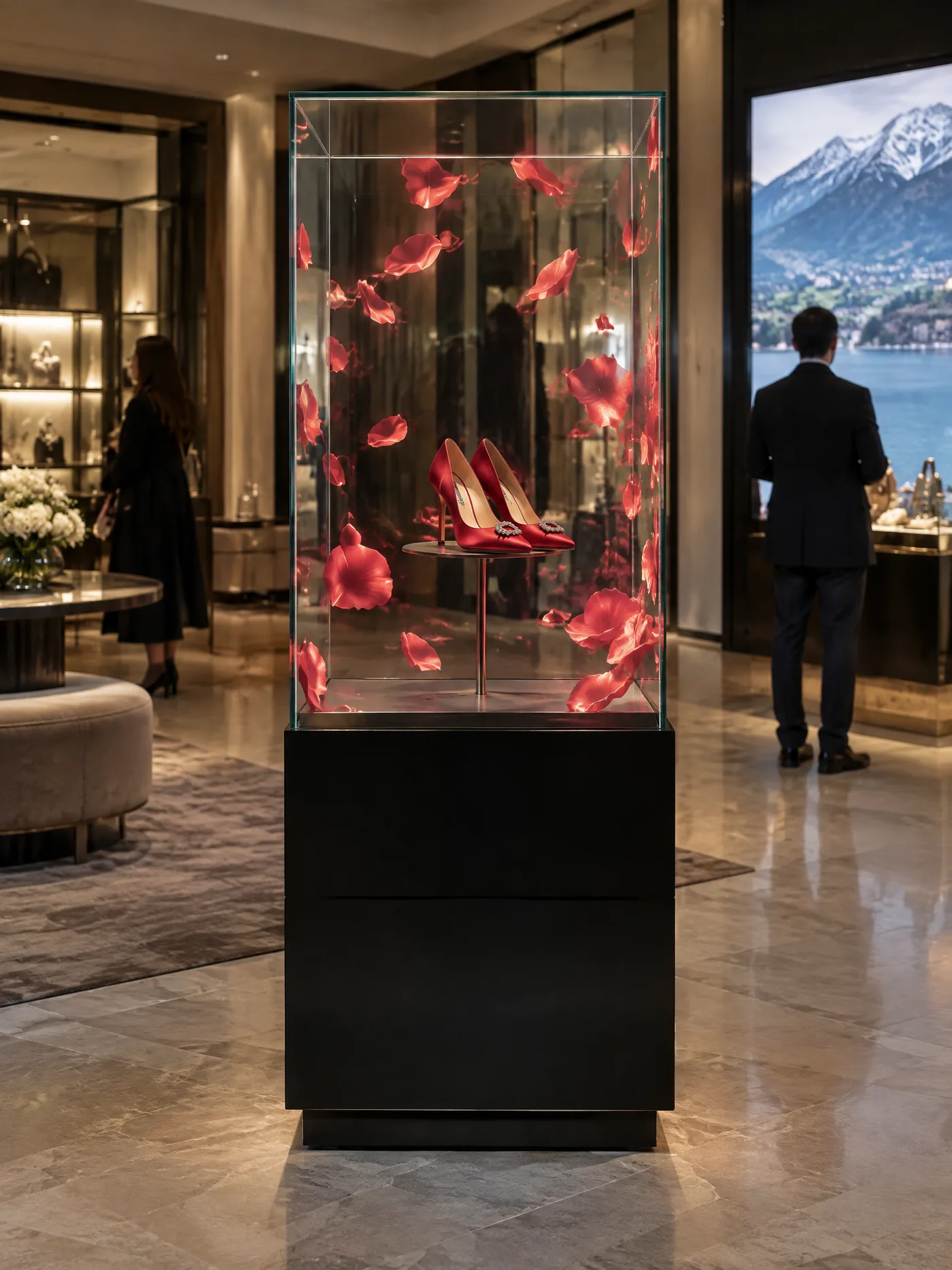
Case study: custom development. A high-jewellery house wanted its shop windows to respond to the people who stop in front of them, without a visible tablet or an intrusive screen, and without filming anyone. The answer: nine boutiques, one display each, hidden behind a two-way mirror, which switches to a dedicated video when someone approaches.
On this page
Key takeaways
- Nine boutiques equipped, one display per window: a consistent network managed from a single point
- Open frame panels set behind two-way mirrors: a mirror when off, a screen when on
- High-brightness panels, 1’000–1’500 nits: the only way to stay readable through shop glass in daylight
- A custom Android application embedded in every display
- Presence detection by silhouette analysis: not simple motion detection
- No photo, no video: the camera feed is analysed locally and never stored or transmitted
- A screensaver plays on a loop by default; the video switches as soon as someone approaches
- Central CMS: content, playback duration and scheduling adjustable per display, remotely
- Panels, frames, cabling, camera installation and configuration: all delivered by HYPERVISUAL
The brief: windows that react, without showing it
In high jewellery, window dressing is a craft. Screens are a delicate tool there: too visible and they break the atmosphere, too discreet and they serve no purpose. The house was looking for a device able to catch the eye at the right moment (when a passer-by approaches) while staying invisible the rest of the time.
A second requirement was non-negotiable in a retail space: no image capture. The installation had to respond to a human presence without ever filming or photographing anyone.
The solution: a display behind the mirror

Open frame panels behind two-way mirrors
HYPERVISUAL supplied open frame panels (professional displays without a housing, designed to be built in), installed behind two-way mirrors inside custom wooden frames. With the display off, the mirror stays a mirror and reflects the boutique. As soon as content plays, the image shows through the mirror coating and the mirror becomes a screen.
One technical point decides everything here: brightness. A consumer panel would be washed out behind shop glass on a bright day. These run at 1’000 to 1’500 nits, several times a standard display, which is what keeps the image readable from the pavement.


A custom Android application in every display
Each unit carries its own Android player and a dedicated camera. We developed a custom application that drives the display locally: it plays the screensaver on a loop, analyses the camera feed and decides on its own when to switch video.
Silhouette detection, without image capture
The trigger does not rely on simple motion detection: a reflection or a change in light would be enough to fool it. The application detects a human silhouette in front of the display. And one point deserves to be stated plainly: the camera takes neither photographs nor video. The feed is analysed on the device to answer a single binary question (is someone there?) and immediately discarded. Nothing is recorded, nothing leaves the display, nobody is identified.
That design choice is what keeps the installation simple in regulatory terms. Silhouette detection is not biometric identification: the system does not recognise faces, does not compare anyone against a database, and infers nothing about emotions, a category the EU AI Act treats with particular caution. With regard to the Swiss Federal Act on Data Protection (FADP) and the GDPR, the installation records no image, transmits nothing and identifies nobody. The rule we apply on every project: content is triggered by a presence, never targeted at a person. The same principle, local analysis with no image stored, also underpins the project described in our case study of a network of ten pop-up stores.
How it reacts to passers-by
The principle fits in one sentence: while nobody is there, the display plays a screensaver, a video running on a loop; as soon as someone approaches the window, the video switches automatically to dedicated content; when they move away, the screensaver takes over again. Interactivity without a button, without a touchscreen and without instructions: approaching is the whole interaction.
Inside the frame

Every frame was assembled before installation: mounting rails, panel, Android player with its Wi-Fi antenna, detection camera on its bracket, power supply and connectors, all integrated inside a felt-lined wooden frame, with a single cable running out to the window’s power outlet. Nothing is visible from the street but the mirror.
One central CMS for the whole network
Every application connects to a CMS that drives the whole network (nine displays across nine boutiques) from a single interface: specific videos per display, playback duration, switching behaviour, scheduling. Everything is configurable remotely, with no intervention in store: the team can change a campaign on one window or across the entire network at once.
End-to-end delivery
On this project HYPERVISUAL handled everything: supplying the open frame panels, developing the Android application, cabling, installing and adjusting the cameras, configuring the CMS and commissioning the system. One provider, one point of contact: the principle we apply to every custom development.
What this project shows
Three convictions. First, interactivity does not require a touchscreen: presence is enough. Second, an intelligent installation can respect people strictly: detecting without identifying, reacting without recording. Third, this kind of project is not bought off a catalogue: the result comes from combining hardware, custom software and physical integration.