MicroLED, MiniLED and COB are three LED display technologies with different strengths: MicroLED leads on contrast and image quality but sits in the highest cost class, MiniLED offers the best price-performance balance for most commercial applications, and COB is the most robust. This comparison explains how each works, where each fits and why site constraints often decide before the technology does.
On this page
Key takeaways
- MicroLED delivers the highest contrast and image quality of the three technologies, but sits in the highest cost class
- MiniLED offers the best price-performance balance for most commercial applications
- COB provides superior durability for high-traffic environments, with costs between MiniLED and MicroLED
- Specify by constraint, not by prestige: viewing distance, available depth, ambient light and service access rule out most options before the technology comparison begins
Why compare MicroLED, MiniLED and COB?
The LED display market is evolving rapidly, and buyers are offered three families of products: MicroLED, MiniLED, and COB (Chip-on-Board). Strictly speaking, the three terms do not describe the same thing: MicroLED and MiniLED refer to the size of the LED chips, COB to the way the chips are mounted, and many fine-pitch COB displays use MiniLED chips. Each family offers distinct advantages for specific applications, but the technical differences can be confusing for decision-makers evaluating their options.
This comparison guide breaks down the essential differences between these technologies, helping you understand which solution best fits your requirements and budget. Whether you’re planning a corporate boardroom display, retail installation, or broadcast environment, understanding these technologies is crucial for making informed investments.
How the three technologies work
MicroLED: the premium choice
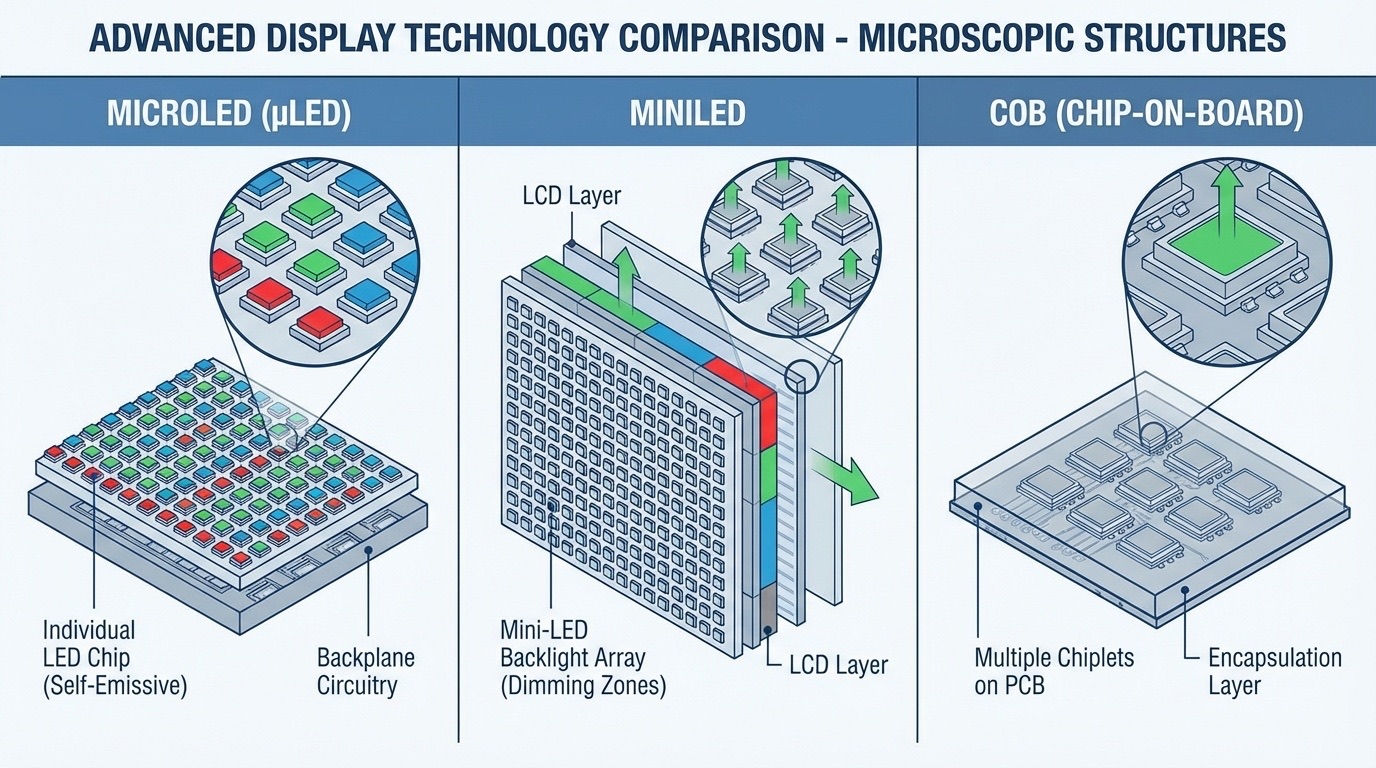
MicroLED uses microscopic LED chips under 100 micrometres in size. Each pixel contains individual red, green, and blue MicroLEDs that emit their own light without requiring backlighting. This self-emissive technology delivers high brightness, true blacks, and very wide viewing angles.
The technology excels in colour accuracy and contrast ratios approaching 1’000’000:1. However, manufacturing complexity keeps MicroLED in the highest cost tier of the three technologies compared here, and it remains reserved for premium installations. MicroLED also exists in a transparent version for glass display cases; HYPERVISUAL sells transparent MicroLED displays for this use.
MiniLED: the balanced option
MiniLED sits between traditional LED and MicroLED, using LEDs sized 100–300 micrometres. Most commonly, MiniLED serves as advanced backlighting for LCD panels, enabling local dimming zones that dramatically improve contrast compared to conventional edge-lit displays.
This technology offers HDR performance approaching OLED at a markedly more accessible cost than MicroLED. Direct-view MiniLED displays also exist, providing fine pixel pitches for professional applications.
COB (chip-on-board): the robust solution
COB technology packages multiple LED chips directly onto a substrate, then covers them with protective resin. This creates a seamless, protected surface that resists impact, dust, and moisture far better than traditional SMD (Surface Mount Device) LEDs.
COB displays typically achieve pixel pitches from P0.9 to P2.5, making them ideal for environments requiring both high resolution and durability. On cost they sit between MiniLED and MicroLED, with pixel pitch the main driver.
Best applications for each technology
Choose MicroLED for:
- Luxury retail flagships requiring ultimate image quality
- Broadcast studios and production environments
- Corporate headquarters where prestige matters
- Museums displaying high-value visual content
Choose MiniLED for:
- Conference rooms and meeting spaces
- Control rooms requiring extended viewing sessions
- Digital Signage with HDR content
- Mid-range retail displays
- Budget-conscious projects needing good performance
Choose COB for:
- High-traffic public environments
- Installations requiring frequent touch or interaction
- Sports venues and entertainment spaces
- Environments with dust, humidity, or vibration
- Rental and staging applications
Key decision factors
Budget considerations
MiniLED offers the best value for most commercial applications, delivering significant image quality improvements over traditional LED at moderate premiums. MicroLED suits projects where image quality comes first and the budget allows it. COB can offer the lowest total cost of ownership once durability and maintenance costs are included.
Environment assessment
Installations facing physical risks (crowds, cleaning, accidental contact) benefit from COB’s protected surface. Climate-controlled spaces can leverage MiniLED’s cost advantages. Premium environments justify MicroLED’s exceptional quality. Understanding how to optimise energy efficiency for your chosen LED technology ensures you maximise both performance and sustainability.
Content type
HDR video content with deep blacks favours MicroLED’s very high contrast. Static corporate presentations work excellently on MiniLED. Mixed-use environments with varied content suit COB’s versatility.
From our projects: the technology we actually specified
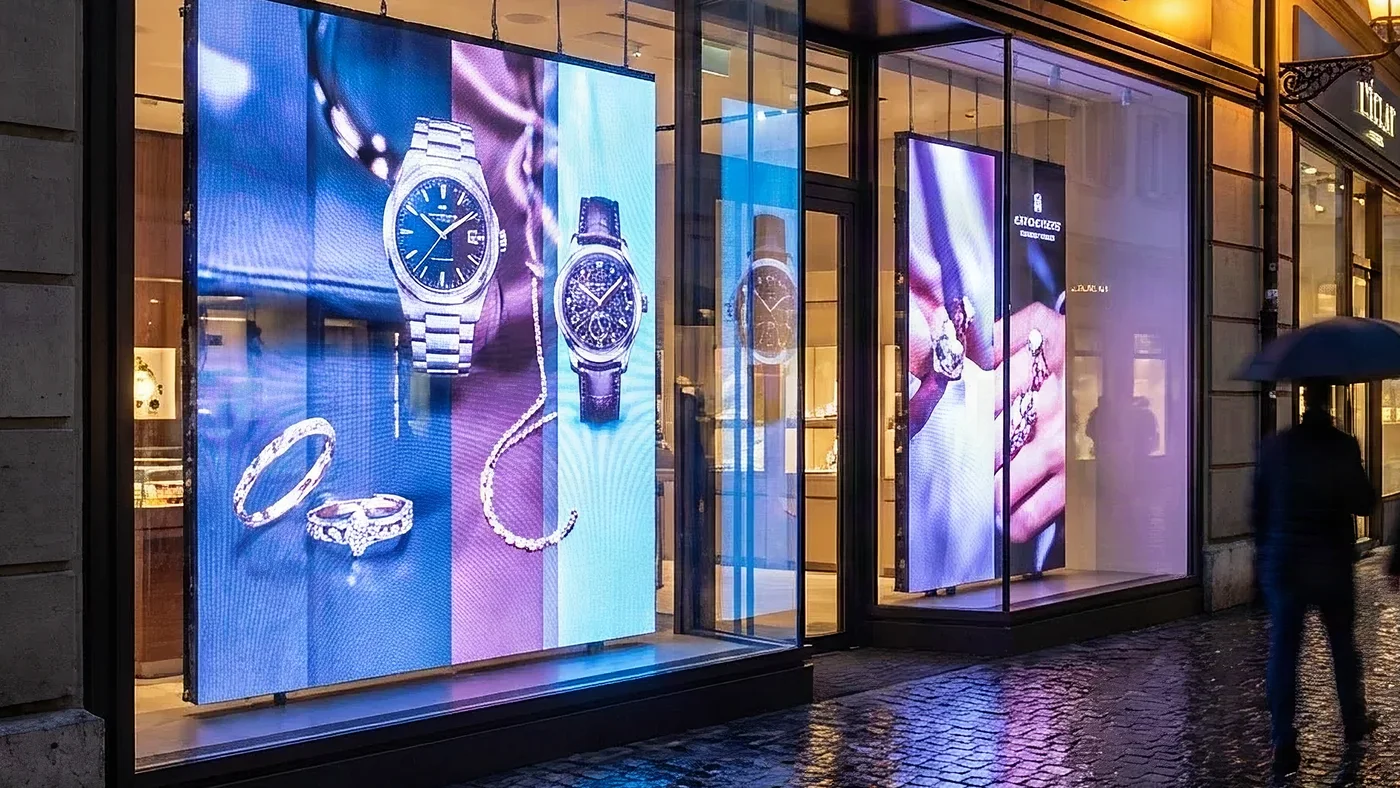
A comparison table can suggest that the newest technology wins. Our own projects rarely conclude that way. For a jeweller’s boutique network (nine shop windows, panels set behind two-way mirrors, documented in our case study on presence detection), the requirement was a built-in panel of a precise size, high enough in brightness to read through shop glass, and serviceable in a shallow window recess. That points to an open frame LCD display, not to a premium LED technology whose advantages the setting would never reveal.
The rule we apply: specify by constraint, not by prestige. Viewing distance, available depth, ambient light, service access and the cost of a failure on a visible site eliminate most options before the technology comparison even begins. MicroLED, MiniLED and COB each win a category: the question is whether your project is in that category.
Future outlook
MicroLED manufacturing costs keep falling as production matures, and the technology is steadily moving toward broader commercial viability. MiniLED continues to improve in parallel, with some panels now approaching MicroLED specifications at a fraction of the cost.
COB technology is gaining market share in professional AV, particularly for rental/staging and permanent installations where reliability outweighs resolution priorities. Proper implementation of any technology requires expertise: our comprehensive LED installation guide covers the complete process from site evaluation through final calibration.
Making your decision
The right choice depends on your specific requirements:
- Define your budget range including installation and 5-year maintenance
- Assess environmental factors like traffic, climate, and physical risks
- Evaluate content requirements for brightness, contrast, and colour accuracy
- Consider future flexibility and technology evolution