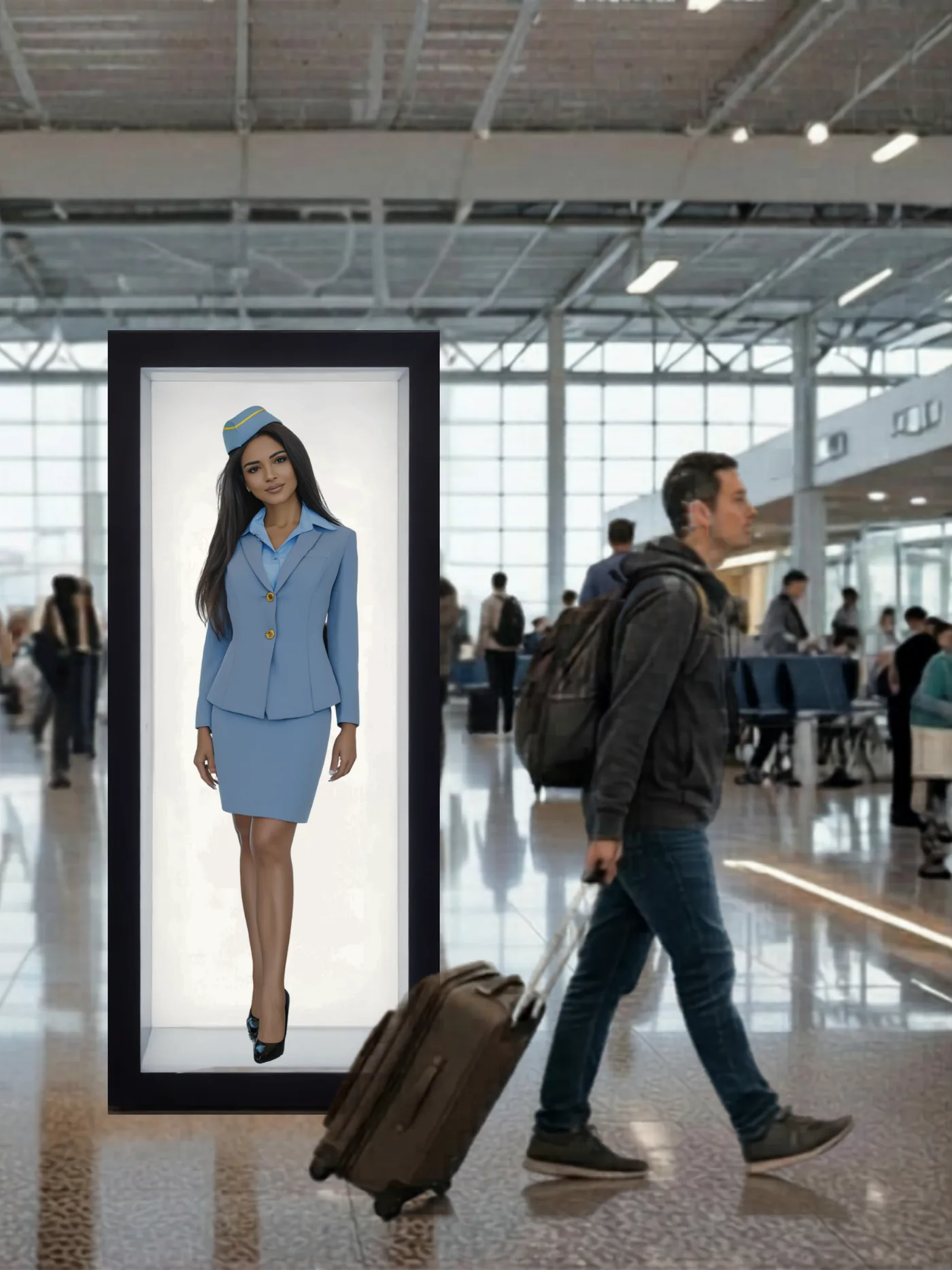
A holographic digital avatar is a life-size virtual person that welcomes visitors and answers their questions in natural language. Its physical presence attracts attention, but trust depends on the reliability of its answers: this article explains how the technology works, how to keep answers reliable and data protected, and where avatars are used, from shops to public institutions.
On this page
Key takeaways
- An AI holographic avatar combines three building blocks: a life-size holographic display, conversational intelligence and presence detection
- Reliability comes from the architecture: pre-configured answers for frequent questions, generation limited to a curated knowledge base, human handoff for everything else
- Privacy by design: no audio or video retention, no facial recognition or emotion detection, anonymised logs, AI hosted in Switzerland
- Applications: retail and hotel reception, corporate lobbies, public institutions, with multilingual service throughout opening hours

Digital avatar technology: AI-powered reception
Holographic digital avatars are transforming reception interactions across industries. They combine conversational AI with a life-size 3D display to create virtual assistants whose interactions come close to a human conversation. For a broader overview of display technologies, read our complete Digital Signage guide.
According to Mordor Intelligence (2026), the global holographic display market is estimated at USD 5.14 billion in 2026 and is expected to reach USD 11.66 billion by 2031, a compound annual growth rate of 17.82%.
What is a holographic digital avatar?
A holographic digital avatar is a virtual human representation displayed in three dimensions, capable of real-time interaction with visitors. Unlike text-based chatbots or faceless voice assistants, it offers a tangible, human-scale physical presence that naturally captures attention.
The technology relies on three essential components: a holographic display system creating the illusion of a person present in the space, conversational intelligence that understands and responds in natural language, and presence detection that triggers the interaction as a visitor approaches.
How do you keep answers reliable?
The main risk of an AI assistant in a public space is the invented answer. HYPERVISUAL’s response, implemented in its HoloBox Nova solution, is a three-tier conversational architecture: frequent questions receive pre-configured, validated answers served almost instantly; more open questions go through generation strictly limited to a knowledge base curated with the organisation (closed domain, the avatar does not answer outside its scope); and anything beyond that triggers a courteous refusal with referral to a human contact.
Around this core: multilingual speech recognition (French, German and English as standard, and up to 38 languages in all), natural voice synthesis with studio voice cloning to embody the brand, real-time lip-sync and a photorealistic 3D avatar. When idle, the screen plays institutional content; as a visitor approaches, the avatar takes over and starts the conversation.
Data protection and accessibility
In Switzerland as in Europe, a reception avatar must be beyond reproach on data. The principles HYPERVISUAL applies: no audio or video retention, anonymised text conversation logs with limited retention, aggregated statistics only, no facial recognition or emotion detection, and non-biometric presence detection (the avatar detects that someone is approaching, never who they are). The AI is hosted in Switzerland.
Accessibility is part of the configuration and is defined for each project, for example the placement of the interaction zone for wheelchair users and the needs of hearing-impaired visitors.
Applications by sector
Retail and luxury
At a store entrance or on the sales floor, the avatar attracts attention, presents new arrivals and guides visitors to the products they are looking for. Premium brands configure avatars that embody their identity (appearance, voice, tone) for a distinctive experience.
Hospitality
Hotels are starting to test the technology. In late 2024, a hotel in Denmark launched a pilot of AI-powered holographic check-in: welcome, frequent questions and arrival formalities are handled in natural conversation, so that the front-desk team can focus on complex requests and personalised service.
Public spaces and corporate
Airports, train stations and shopping centres deploy avatars for wayfinding and information. In corporate environments, they welcome visitors in lobbies and embody the brand at events.
Institutions and education
Universities, public administrations and museums gain a multilingual information desk available throughout opening hours: campus wayfinding, answers to recurring administrative questions, exhibition presentations, with human handoff as soon as a request leaves the configured scope. Our case study of a holographic avatar at a Swiss university reception describes such a project.
Key benefits for organisations
Availability throughout opening hours: a reception service without fatigue or variation in quality, valuable for venues with long opening hours and international visitors.
Native multilingualism: the conversation adapts to the visitor’s language, without staffing a polyglot team on site.
Consistent answers: the curated knowledge base ensures an accurate message, identical at every hour of the day, as long as it is kept up to date.
Relieved teams: repetitive questions are absorbed by the avatar; staff focus on high-value requests.
Memorable impact: a reception experience visitors talk about, a durable brand differentiator.
Integration and deployment
Implementation follows a structured method. Everything starts with a knowledge base scoping workshop: identifying, validating and phrasing the content the avatar is allowed to give. This content is the critical deliverable of the project. A persona workshop then defines the avatar’s appearance, voice and personality in line with the brand.
If necessary, we visit the site to check the location, ambient light and site constraints before installation. The configuration integrates with existing systems where relevant, and handover includes team training, followed by maintenance if you wish.
HoloBox Nova: HYPERVISUAL’s holographic avatar
Holographic avatars are redefining reception standards: physical presence, conversational intelligence bounded by design, and availability throughout opening hours. With the HoloBox Nova, HYPERVISUAL configures complete AI holographic avatars (HoloBox hardware, conversational pipeline and curated knowledge base) for Swiss and European organisations, from scoping to operational deployment. The difference from the HoloBox is simple: the HoloBox plays content, the HoloBox Nova answers. The HoloBox Nova is available for purchase only.