Digital Signage means screens whose content is managed and scheduled centrally, from a single screen to a network of sites. This guide explains what a system is made of, how to choose the display technology and the software, how each sector uses it, how to estimate the return on investment and how to deploy it in five phases.
On this page
Key takeaways
- The global Digital Signage market, valued at USD 31.1 billion in 2025, is projected to reach USD 58.4 billion by 2033, a compound annual growth rate of 8.2% from 2026 to 2033 (Grand View Research, June 2026 edition)
- Three pillars make a system: hardware, management software and content, and it is almost always the third that decides the outcome
- ROI is best reasoned in proportions: what the installation costs relative to the outlet’s revenue, against what it brings in (margin on additional sales, printing avoided)
- The structural choices (display technology, pixel pitch, cloud or on-premise) follow from viewing distance, ambient light and the way you intend to operate, not from a catalogue
Source: Grand View Research, Digital Signage Market Analysis
For the Swiss market specifically, read our overview of the key Digital Signage market trends in Switzerland.
What is Digital Signage?
Digital Signage is the use of networked digital screens to distribute visual content centrally and on a schedule. Unlike static media such as printed posters or panels, it lets you change what is displayed instantly, programme content playlists and adapt your communication in real time.
The components of a complete system
A professional Digital Signage system rests on three pillars. The hardware covers the displays (LED, LCD, OLED), the media players and the network infrastructure. The software is the CMS (Content Management System) that manages and distributes the content. Finally, the content itself is the strategic element that determines the impact of your communication.
How it differs from static signage
Digital Signage outperforms static displays on several critical dimensions. Flexibility: content changes in a few clicks, with no printing costs and no posters to distribute. Engagement: dynamic screens hold attention markedly longer than static media. Measurability: built-in analytics quantify the audience and the impact.
Professional display technologies
Choosing the display technology is a strategic decision that shapes visual quality, durability and the total cost of ownership of your installation.
LED displays: the reference for large formats
LED screens are the reference for large formats and bright environments. Brightness is their first strength: outdoor LED displays reach 5’000 nits and more, which keeps content readable even in direct sunlight, while indoor models work at much lower levels. Their modularity allows made-to-measure configurations, from small welcome screens to very large LED walls. Their lifespan is long: they are built for continuous operation over many years.
The pixel pitch, the distance between the centres of two adjacent pixels, determines resolution and the optimal viewing distance. A 1.5 mm pitch suits spaces where the audience stands within 2 metres, while a 4 mm pitch is enough for installations viewed from 5 metres or more; as a rule of thumb, allow about 1 metre of viewing distance per millimetre of pitch. This technical characteristic drives the budget directly: the finer the pitch, the higher the cost per square metre. Our LED video wall buying guide explains these choices in more detail.
Professional LCD displays
LCD screens remain relevant for certain applications, particularly indoor environments with controlled lighting. Their main advantage is a lower acquisition cost than equivalent LED solutions. Professional models differ from consumer screens in being built for continuous operation, with higher brightness and appropriate connectivity.
Emerging technologies: MicroLED and transparent displays
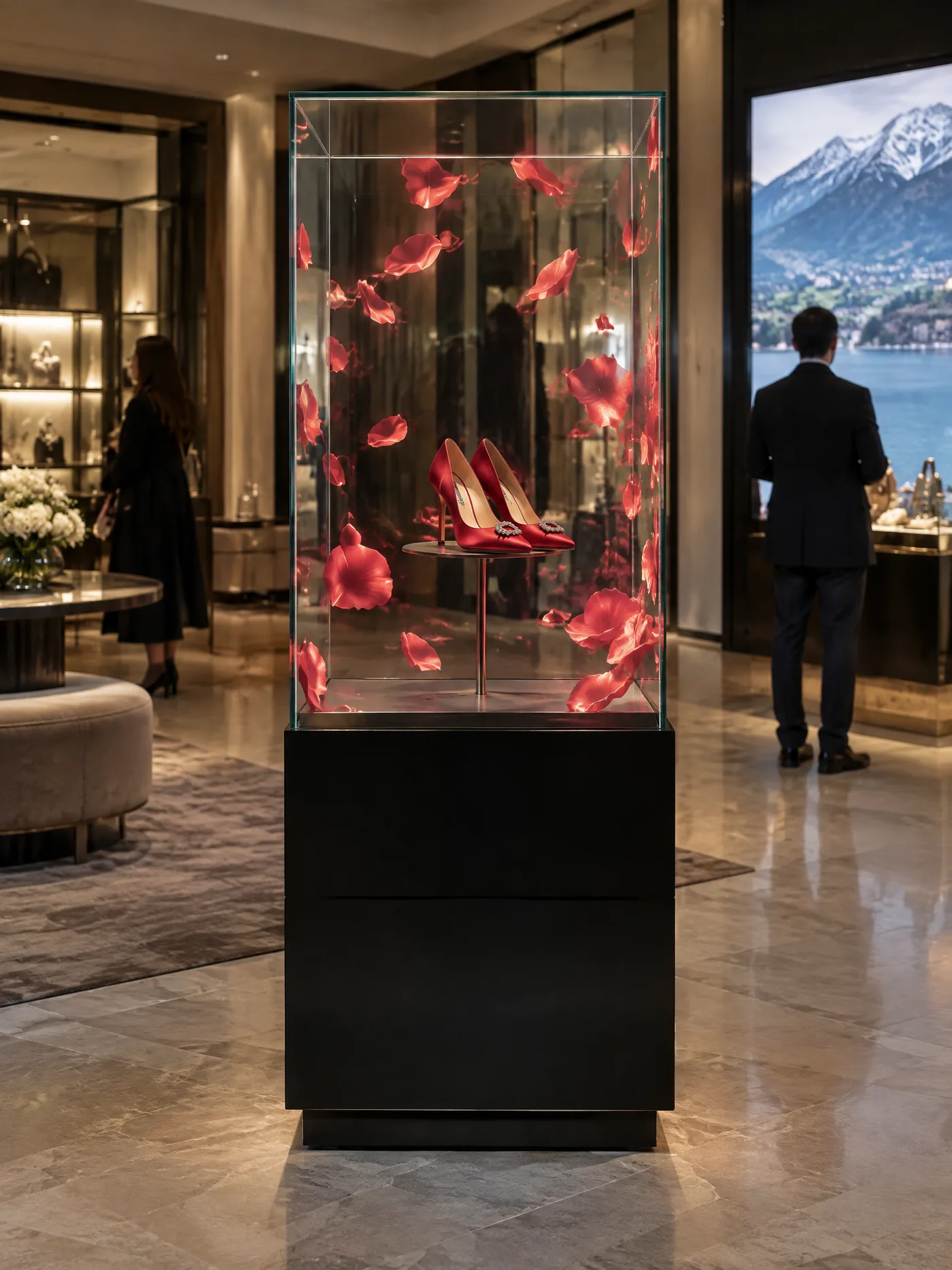
MicroLED takes LED technology further, with microscopic diodes that allow very fine pitches, deep blacks and very high contrast. Transparent displays show content while keeping the view through the glass: transparent LED film and invisible holographic LED suit shop windows and glass façades, while transparent OLED and MicroLED are made for display cases.
CMS software and content management
The management software is the brain of your Digital Signage system. It determines ease of use, available features and how far your installation can scale.
Essential features of a modern CMS
A professional CMS must offer an intuitive interface that lets non-technical teams create and schedule content. Multi-site management centralises control of dozens or hundreds of screens on a single platform. Data integration connects the signage to your existing systems: ERP, social feeds, weather, RSS.
Advanced features include conditional scheduling, which adapts content to the time, the day or external triggers, and built-in analytics that measure audience and engagement to sharpen your content strategy. Our comparison of Digital Signage software platforms maps the main solutions on the market and gives a method for choosing.
Cloud vs on-premise
Cloud solutions offer fast rollout, automatic updates and access from anywhere. They particularly suit multi-site deployments and companies that value flexibility. On-premise solutions meet the strictest security requirements and work in environments without reliable internet connectivity.
Analytics and audience measurement
Modern systems integrate presence detection and anonymous audience measurement. DATAVSN, the software developed by HYPERVISUAL and hosted in Switzerland, is built in layers: the CMS is the base, anonymous audience recognition comes next (anonymous counting, stop rate, dwell time, as well as aggregated gender and age range), and interactivity last. No one is identified: there is no facial recognition and no emotion detection. The data serves to optimise the content and to demonstrate ROI to stakeholders.
Applications by industry
Digital Signage finds specific applications in every sector, with measurable benefits and proven use cases.
Retail
Retail is one of the largest users of Digital Signage. Applications include digital shop windows that catch passers-by, shelf-edge screens that inform about products, and checkout displays carrying promotions and brand communication.
The most direct benefit is flexibility: adjusting promotions in real time to stock levels and seasonality, with no reprinting and no delay. Audience measurement then verifies, screen by screen, what actually holds attention.
Hospitality
Hotels use Digital Signage for welcome and wayfinding, displaying available services and promoting additional offerings. Restaurants adopt digital menu boards that change dishes and prices instantly and put the right items forward at the right hours.
Corporate and workspaces
Internal communication benefits considerably from Digital Signage. Lobby screens professionalise the company’s image, HR displays carry news and indicators, and meeting rooms gain interactive screens. The gain rides on freshness: a channel that teams watch because it says what is happening today, not what happened last month.
Transport and Smart Cities
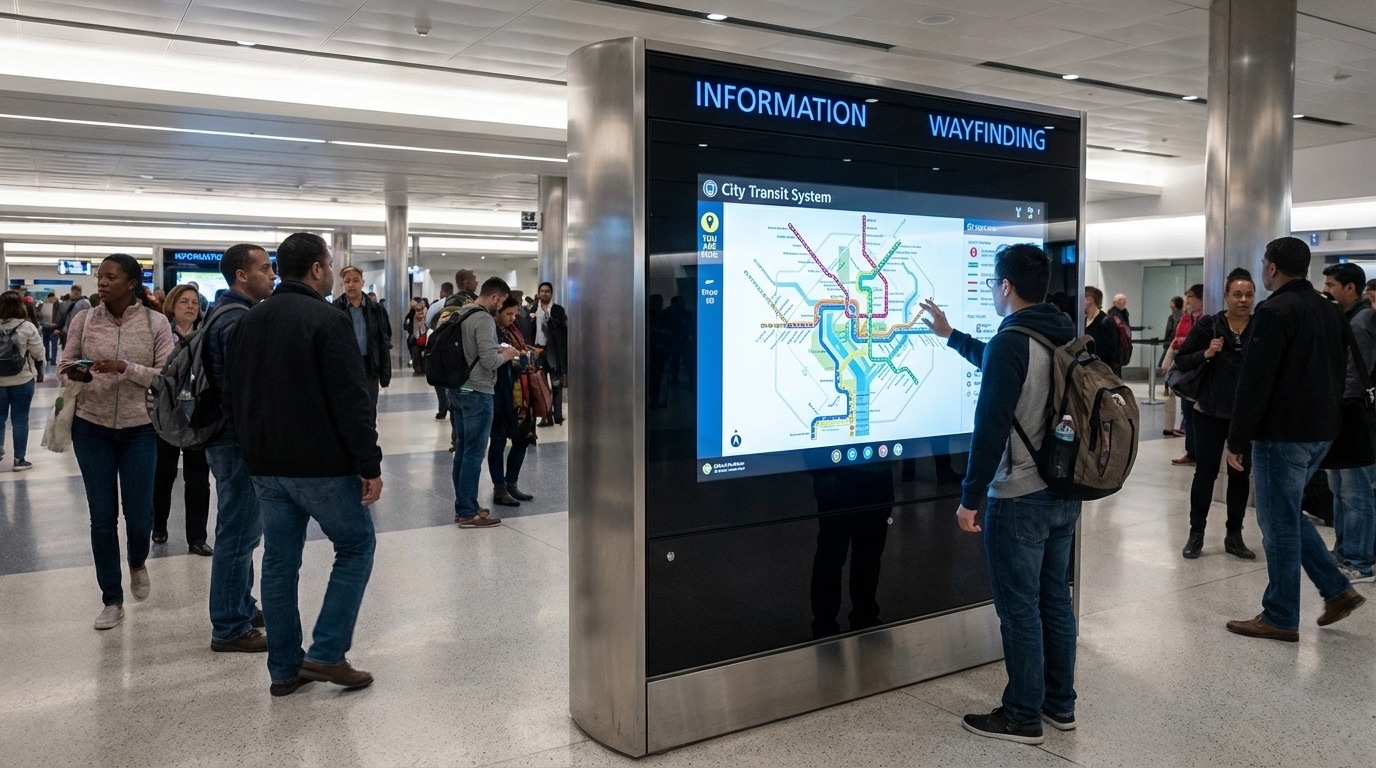
Stations, airports and public transport networks are natural environments for Digital Signage. Real-time passenger information improves the traveller experience, while advertising space generates significant additional revenue.
Museums and culture
Cultural institutions use Digital Signage to create immersive experiences, provide contextual information about the works and ease visitor wayfinding. Interactive and holographic technologies open new dimensions of engagement with audiences.
Calculating the ROI of your investment
A Digital Signage investment should be assessed with a rigorous method that captures all costs and all benefits.
Cost structure
The initial cost covers hardware (screens, players, infrastructure), software (CMS licences), installation and training. Installation is a significant share of the hardware budget, and it is the item most often underestimated. The absolute level depends chiefly on two factors: the display technology chosen, and the pixel pitch for LED.
Recurring costs include the CMS subscription (usually billed per screen), content creation, maintenance and energy. Maintenance comes back every year and content takes a substantial share of the overall budget: both are lines to plan from the start rather than discover later.
Sources of return
Quantifiable benefits come from several sources. The sales uplift directly attributable to the signage is the most immediate gain. The reduction of printing and logistics costs generates recurring savings. The improved brand image feeds retention and customer acquisition over the long run.
The ROI formula
ROI follows the formula: (Gains − Costs) / Costs × 100. The most robust approach is to reason in proportions of the outlet’s revenue: if the first-year cost represents 2% of revenue and the gains (margin on additional sales plus printing savings) represent 3%, first-year ROI comes out at 50%, and the ratio holds whatever the size of the business.
The payback period follows directly from that ratio: the higher the recurring gains relative to the initial cost, the sooner the break-even point arrives. That is the ratio to estimate honestly before investing, not a generic promise.
Implementation in five phases
A successful Digital Signage project rests on a structured method covering the whole life cycle.
Phase 1: needs analysis
This foundational phase defines the business objectives (sales, image, information), identifies the strategic locations, characterises the target audiences and sets the available budget. The technical constraints (power supply, network connectivity, lighting conditions) are then checked, on site if necessary.
Phase 2: solution design
Design translates needs into technical specifications. The choice of displays follows from viewing distance, ambient brightness and budget. The CMS selection depends on the required features and the intended operating model. The network architecture is designed for reliability and security.
Phase 3: installation and configuration
Physical installation covers mounting the screens, cabling and network configuration. Software setup includes creating user accounts, defining display zones and functional testing.
Phase 4: content creation
Content determines the impact of your installation. Good practice includes short, punchy messages, high-quality visuals and display durations suited to the context (as a rule, 8 to 12 seconds per message, 5 to 10 seconds in passing areas). Building an initial template library makes regular updates easy.
Phase 5: training and operations
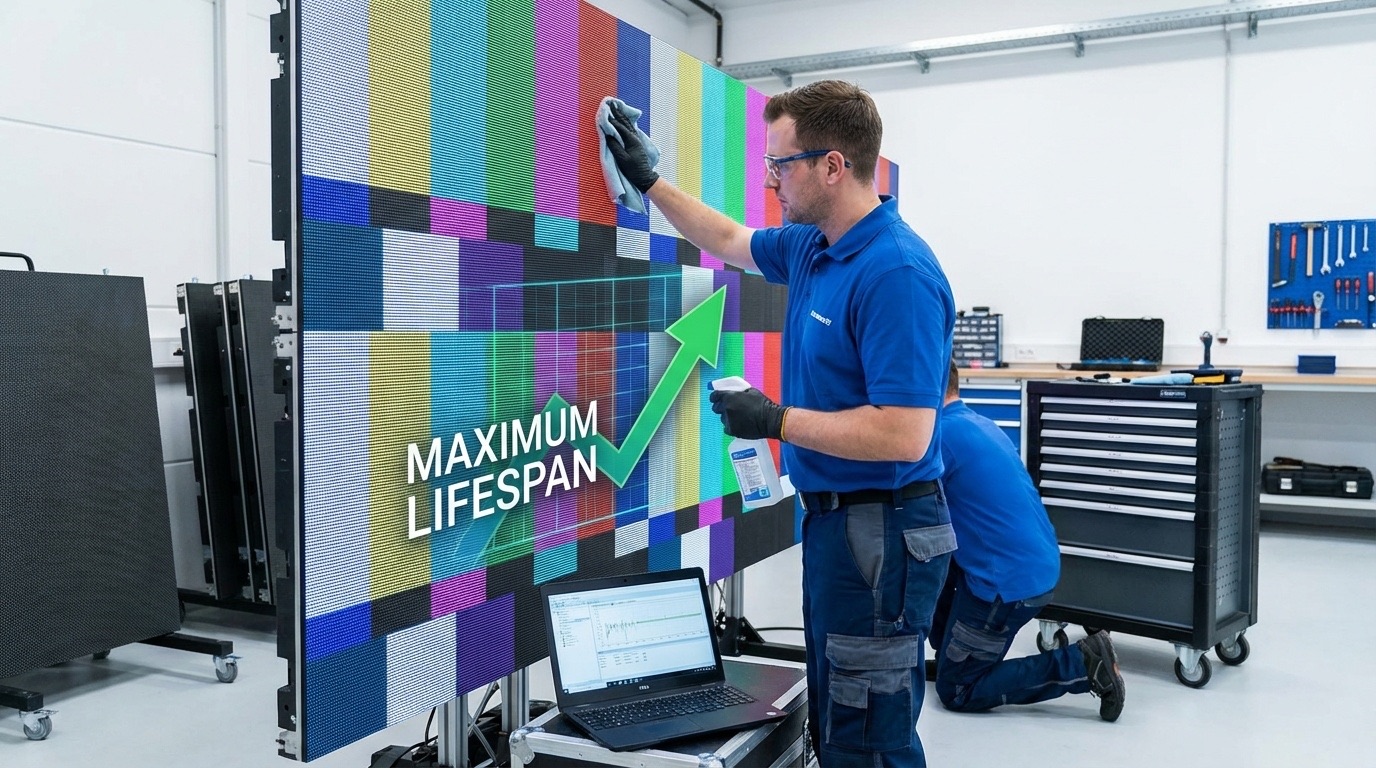
User training gives teams autonomy for day-to-day operations. A preventive maintenance plan extends hardware life. Your team’s regular review of the performance data in the CMS keeps the system optimised over time.
Trends and innovations
The Digital Signage industry is seeing an acceleration of innovation that expands both creative and operational possibilities.
Artificial intelligence and personalisation
Generative AI is transforming content creation by automating the production of visuals and context-appropriate messages. Personalisation algorithms use anonymous audience data in real time to serve the most relevant content. These technologies can raise impact while reducing creative production costs.
Holography and 3D display
Holographic displays, such as the HYPERVSN 3D hologram fans that HYPERVISUAL sells and rents in Switzerland, show images that seem to float in mid-air. Because the effect is unusual, it catches the eye in a way a flat screen rarely does.
Interactivity and sensors
Integrating presence sensors triggers contextual content as visitors pass. Touch screens and gesture recognition turn passive displays into interactive experiences.
Sustainability and energy efficiency
Each generation of LED displays consumes noticeably less than the one before: the gains come from the panels themselves as much as from brightness control slaved to ambient light. Environmental certifications and corporate ESG commitments are accelerating the adoption of responsible solutions.
Frequently asked questions
How much does a complete Digital Signage system cost?
The budget depends on four factors, in this order: the display technology (LED costs more than LCD for the same surface), the pixel pitch for LED (the finer, the higher the cost per square metre), the number of screens, and the expected service level. A single-screen installation with a cloud CMS is the entry point; a made-to-measure LED wall plays in an entirely different category. The only reliable figure is a quote for your actual configuration, not a comparison of generic ranges.
What is the lifespan of a professional LED display?
Professional LED displays are built for continuous operation over many years, and they generally last longer than professional LCD screens. The rated lifetime appears in each model’s data sheet. Preventive maintenance and operating conditions significantly influence real-world longevity.
Is a permanent internet connection required?
No. Most systems run autonomously thanks to local content storage. The internet connection lets you update content and check your screens remotely from the CMS, but it is not essential to daily operation. Hybrid architectures combine local autonomy with central management.
How do I choose between LED and LCD?
LED wins for outdoor applications, large formats and high-brightness environments. LCD suits moderate-sized indoor installations with controlled lighting and tighter budgets. LED offers better durability and modularity, at a higher cost.
Can several sites be managed from one platform?
Yes. Professional CMS platforms provide centralised multi-site management. One administrator can control hundreds of geographically distributed screens, distribute identical or differentiated content per location, and produce consolidated reports. Our case study of ten pop-up stores run as a single screen network shows how such a network is designed.
Conclusion
Digital Signage is now a competitive advantage within reach of businesses of every size. With a growing market and technologies that keep gaining in performance and accessibility, the conditions for investing in this communication channel are right.
The benefits are measurable: higher sales, a stronger brand image, better internal communication. And the return is a ratio you can estimate before committing, not a leap of faith.
HYPERVISUAL has supported Swiss and European companies in their Digital Signage projects since 2017. Our work covers the whole chain: advice, sale and rental of LED screens and holograms, software integration, installation and maintenance.