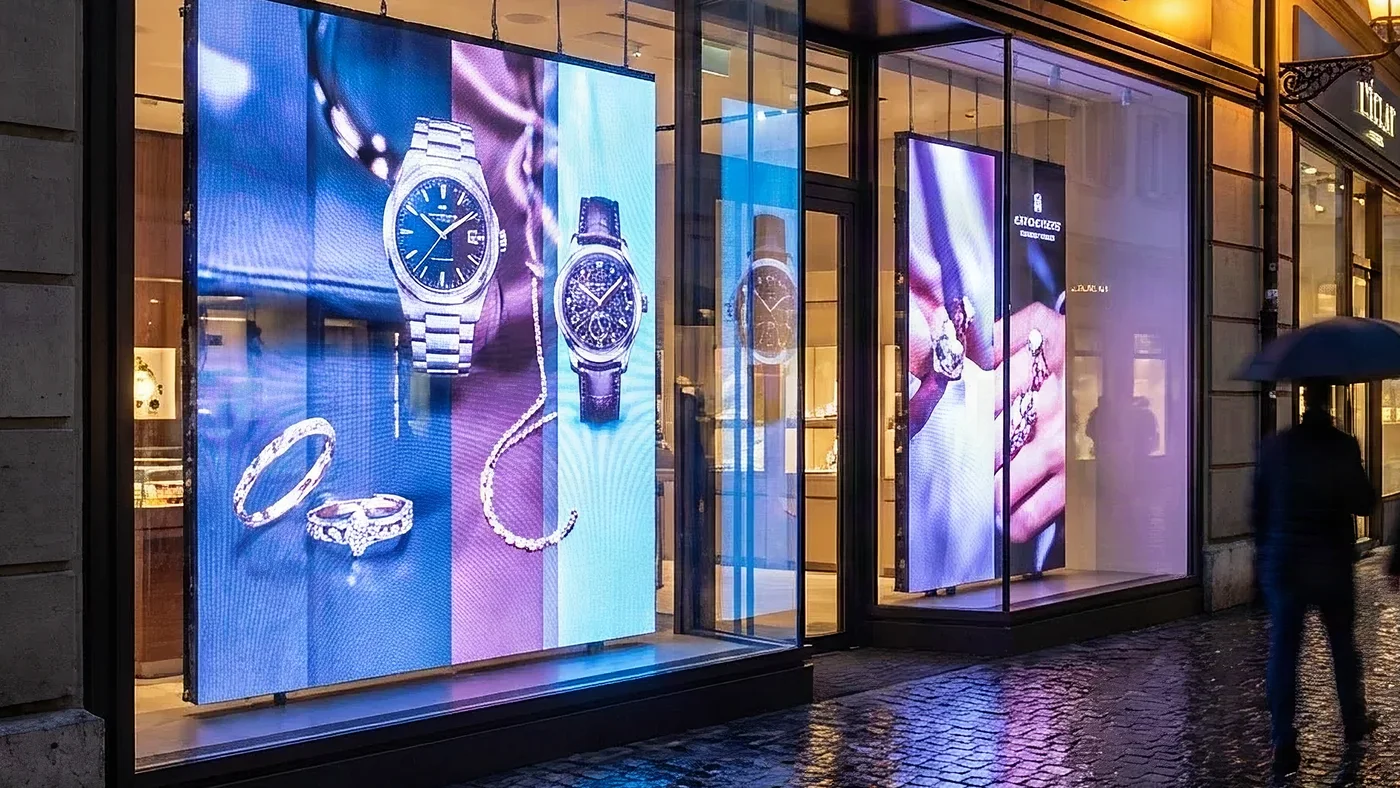
The right LED video wall starts with the viewing distance: it sets the pixel pitch, which in turn drives resolution and budget. This guide explains that choice, then covers the three LED packaging technologies (SMD, COB and MIP), indoor and outdoor specifications, control systems, installation planning and total cost of ownership.
On this page
How LED video walls work
LED video walls create seamless large-format displays by combining modular panels into unified visual surfaces. Unlike projection or LCD screens, LED walls produce their own light at every pixel, through thousands of individual light-emitting diodes, which gives them higher brightness and contrast and a long service life.
The fundamental building block of any LED video wall is the pixel, a cluster of red, green, and blue LEDs that combine to produce full-colour imagery. How these pixels are manufactured, packaged, and arranged determines everything from image quality to maintenance requirements and total cost of ownership.
The pixel pitch decision: finding your optimal resolution
Pixel pitch measures the distance in millimetres between the centre of one pixel and the centre of the next. It is usually the first specification to settle, because it directly determines resolution, the suitable viewing distance and the level of investment.
Fine pixel pitch (under 1.5 mm)
Premium installations requiring close viewing distances. Control rooms, broadcast studios, corporate boardrooms, and luxury retail environments typically require P0.9 to P1.5 displays. These represent the highest investment tier but deliver exceptional image quality for demanding applications where viewers sit within 2–3 metres of the screen.
Standard pixel pitch (1.5 mm to 2.5 mm)
The sweet spot for most commercial indoor applications. Conference rooms, lobbies, museums, and hospitality venues achieve excellent results with P1.8 to P2.5 displays. This category offers the best balance between visual quality and investment.
Large pixel pitch (over 2.5 mm)
Optimised for longer viewing distances in large venues, outdoor installations, and digital billboards. Stadium displays, transportation hubs, and outdoor advertising typically use P4 to P10 panels.
Rule of thumb: allow roughly one metre of minimum viewing distance for each millimetre of pixel pitch. A P2.5 screen, for example, is best viewed from about 2.5 metres or more.
LED packaging technologies: SMD vs COB vs MIP
Surface-mounted device (SMD)
SMD technology remains the industry workhorse, mounting individual LED packages onto printed circuit boards. This mature approach offers established manufacturing processes, widespread availability, and modular serviceability.
SMD displays excel in outdoor applications where brightness requirements typically reach 5’000–8’000 nits. However, SMD’s exposed components remain more vulnerable to physical damage.
Chip-on-board (COB)
COB technology represents a significant advancement in durability and visual quality. By mounting LED chips directly onto the substrate and covering them with a protective epoxy layer, COB panels achieve superior impact resistance and thermal management.
COB panels can reach comparable brightness with lower power consumption, helped in part by better heat dissipation.
Micro LED in package (MIP)
MIP is a more recent packaging approach that bridges the gap between MiniLED and MicroLED displays. It allows individual pixels to be repaired and can be used across a range of fine pixel pitches.
Indoor vs outdoor specifications
Indoor LED video walls
Indoor LED walls prioritise image quality. Brightness requirements typically range from 600–1’500 nits. Indoor panels feature cabinet designs optimised for front serviceability.
Outdoor LED displays
Outdoor installations must withstand direct sunlight, precipitation, and temperature extremes. IP65 or higher protection ratings ensure reliable operation. Brightness capabilities of 5’000–8’000 nits maintain visibility against direct sunlight.
Control systems and signal processing
LED controllers receive the video sources, scale them in real time and manage colour. Entry-level controllers typically show one source at a time; professional video processors combine several 4K sources on the same wall, with advanced features such as HDR processing.
Point-by-point calibration: measures and adjusts individual LEDs for maximum uniformity, eliminating the visible panel boundaries that distinguish amateur from professional installations.
Freeze the screen dimensions before building the structure
On our integration projects, the most expensive mistake is chronological, not technical. In a design study for an international brand’s pop-up stores in Switzerland, we reversed the usual order: the exact panel dimensions (overall frame, visible area, thickness) were frozen first, and the furniture makers were then asked to design their structures around them. The classic failure runs the other way: joinery built, delivered, and a display that no longer fits or leaves gaps that betray the assembly.
A video wall raises the same question on a larger scale. Cabinet dimensions, module tolerances, rigging points and service access have to be settled before the supporting structure is fabricated, not after. Preparation follows the same logic: for a jeweller’s boutique network, the displays were pre-assembled with their players and cabling before they reached the boutiques, as described in our case study on presence detection. On site, only the fitting should remain.
Planning your LED video wall installation
Successful installations begin with thorough site evaluation:
- Structural analysis: confirms wall or floor can support display weight (typically 30–50 kg/m²)
- Electrical assessment: ensures adequate power availability
- Environmental factors: ambient light levels, HVAC capacity, and maintenance accessibility
Total cost of ownership
LED video wall projects involve multiple cost categories: display hardware including panels and mounting systems, control infrastructure, professional installation, and ongoing operational expenses.
Energy consumption represents a substantial ongoing cost. COB and MIP technologies can consume less energy than equivalent SMD solutions.
Maintenance planning: set aside an annual budget for maintenance and the eventual replacement of components.
Making your decision
LED video wall selection requires balancing multiple factors: viewing distance determines appropriate pixel pitch, application environment influences technology choice, and available budget shapes project scope.