Museums are using interactive displays to bring their collections to life for today’s visitors, provided the technology enhances rather than overshadows the objects. This guide covers the main applications, examples from Swiss museums, the technical choices and the practices that make a project succeed.
On this page
Why museums are embracing digital transformation
The challenge of modern audiences
Today’s museum visitors arrive with smartphones in hand and expectations shaped by digital experiences. Many find technology assistance helpful during their visit, and interactive displays invite a more active engagement than static signage.
The challenge for cultural institutions lies not in whether to adopt digital technology, but how to implement it thoughtfully. The most successful museum digital transformations enhance storytelling without creating barriers between visitors and collections.
The business case for digital investment
Digital Signage also brings operational benefits. Interactive wayfinding reduces the time staff spend on directional questions, while digital interpretation systems allow institutions to serve multilingual audiences without duplicating physical signage. More importantly, engaging digital experiences influence return visits and positive word-of-mouth recommendations.
Key applications of Digital Signage in museums
Interactive wayfinding systems
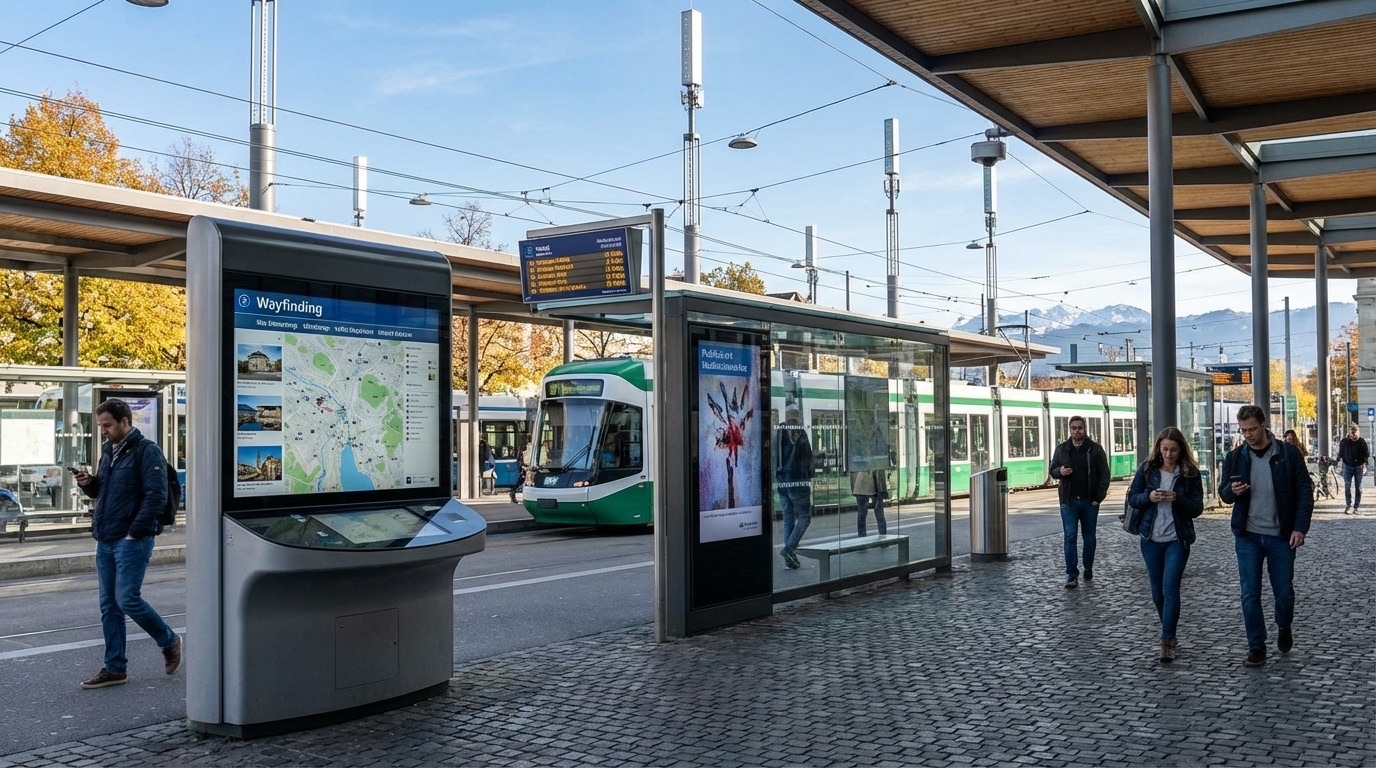
Large museums with multiple floors and extensive collections present navigation challenges that frustrate visitors. Digital wayfinding kiosks with 3D maps, touch-screen directories, and personalised tour suggestions transform this pain point into an opportunity for engagement.
The most useful systems link wayfinding with exhibition information, so that visitors can plan their route according to the time available, their interests and their accessibility requirements, with temporary exhibitions highlighted.
Immersive storytelling with video walls
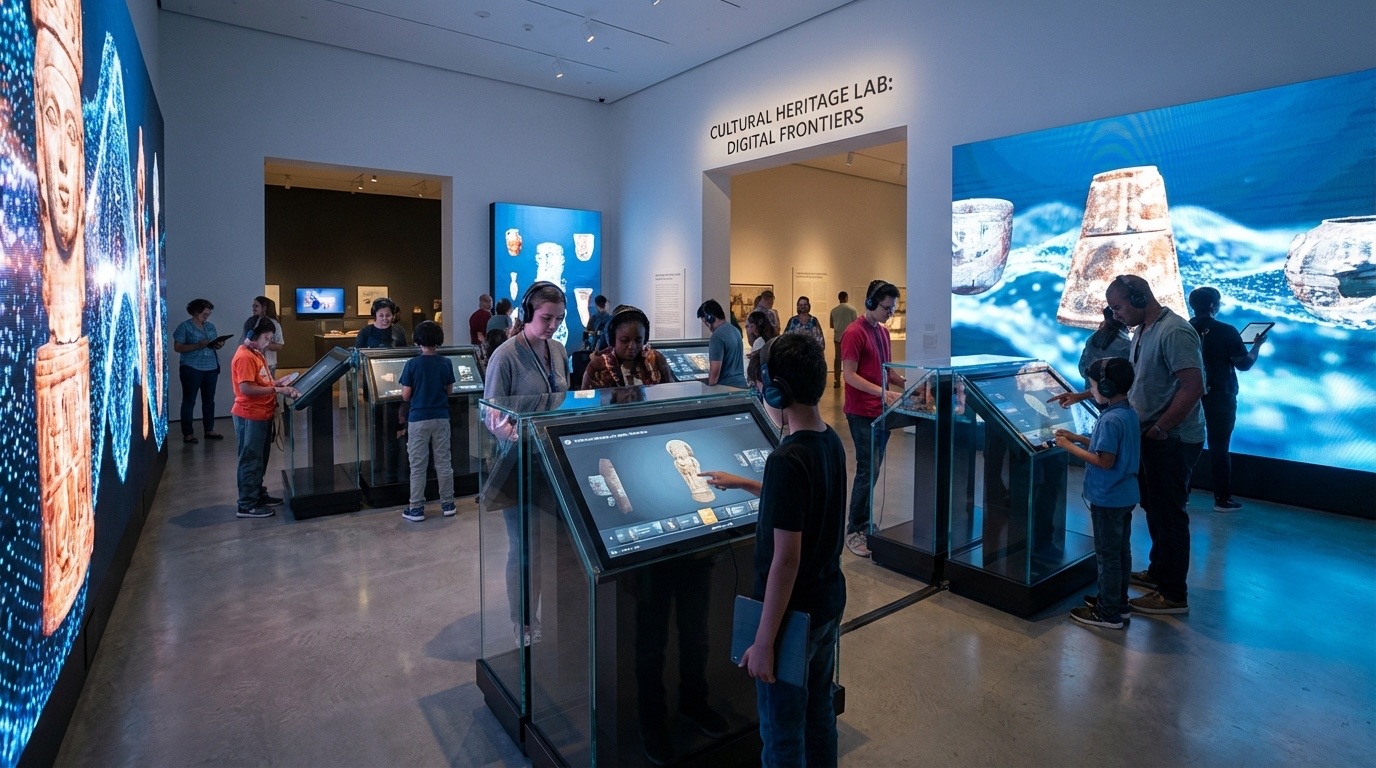
Video walls create focal points that draw visitors into narratives impossible to convey through static displays alone. Projection mapping works in the same spirit, turning architectural elements or scale models into storytelling surfaces.
Immersive installations that combine images with spatial sound create memorable moments that visitors share on social media, extending the museum’s reach far beyond its physical walls.
Augmented reality experiences
AR technology allows museums to overlay digital information onto physical exhibits without compromising the integrity of original artefacts. Visitors can use their smartphones or museum-provided devices to access contextual information, view reconstructions of damaged artworks, or see historical objects in their original settings.
Interactive learning stations
Touch-screen stations positioned throughout galleries transform passive observation into active learning. They allow visitors to explore subjects at their own pace and depth, and multiple interaction modes accommodate different learning styles and accessibility needs.
The deliverable that decides an interactive project
We have scoped a holographic information avatar for a Swiss university of applied sciences: a campus assistant that answers visitor and student questions in several languages (see our case study of the holographic avatar). The lesson transfers directly to museum projects, and it has nothing to do with the display: the critical deliverable is the knowledge base. Which questions may be answered, in whose words, validated by whom. An avatar or a kiosk that improvises on a collection is worse than a printed panel; one that answers a curated set of questions accurately, and politely refers everything else to staff, earns trust.
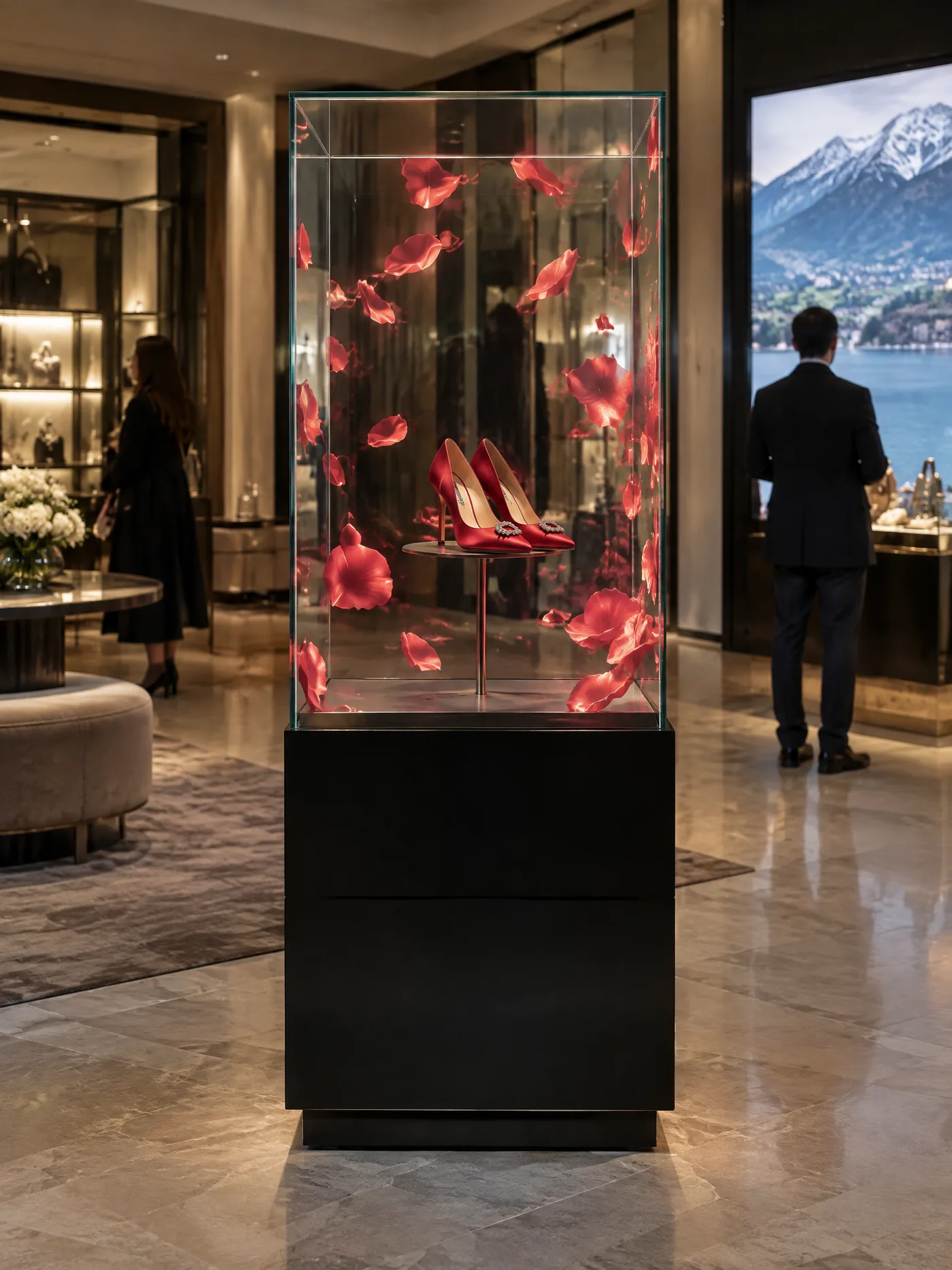
The second transferable choice is privacy. In that configuration, as on the jewellery windows in our case study on presence detection, the installation reacts to a presence without identifying anyone: no facial recognition, no emotion inference, nothing recorded. In a museum, a place of public trust that often welcomes school groups, that architecture is not a detail but a precondition.
Examples from Swiss museums
The installations below were created by the museums and their own partners; they are cited as illustrations and are not HYPERVISUAL projects.
Swiss National Museum, Zurich
When its permanent exhibition “History of Switzerland” opened in 2009, the Landesmuseum introduced an interactive 3D projection on the staircase, giving an overview of the exhibition areas, and a monastery model brought to life by changing light and spatial sound, with a touchscreen to explore it.
In 2016, the museum opened the permanent exhibition “Ideas of Switzerland” in its new wing, featuring four interactive digital books on direct democracy, the militia system, the economy and diplomacy. In both cases, the media are part of the exhibition design rather than technological afterthoughts.
Museum für Gestaltung, Zurich
The exhibition “Museum of the Future” (August 2025 to February 2026) presented 17 digital experiments developed with partners including EPFL’s Laboratory for Experimental Museology, ETH Zurich and ZKM. It explored technologies such as gigapixel imaging, 3D scanning, generative AI and immersive visualisation.
Among the experiments was a 1.6-terapixel panorama, which the organisers describe as the largest digital image of a single object ever created: an illustration of the scales of visual experience that digital technology makes possible.
Technology considerations for museum implementation
Display selection
Museum environments present unique challenges for display technology. Ambient lighting varies dramatically between galleries, requiring screens with appropriate brightness levels: around 500 nits is typical indoors, while areas exposed to daylight need 1’000 nits or more. LED video walls offer seamless large-format displays for immersive installations, while high-resolution LCD touchscreens suit interactive stations.
Energy efficiency increasingly influences procurement decisions, with museums seeking displays that minimise environmental impact while maintaining visual quality. Recent LED technology consumes less power than previous generations.
Content management systems
Museums require CMS platforms capable of managing multilingual content across dozens or hundreds of displays simultaneously. Cloud-based systems enable remote content updates while maintaining consistent visitor experiences across all touchpoints.
Integration with collection management databases allows digital displays to pull accurate, curator-approved information automatically, reducing maintenance burden while ensuring accuracy. Scheduling capabilities enable content to adapt based on time of day, special events, or temporary exhibitions.
Visitor analytics
Anonymous audience recognition (anonymous counting, stop rate, dwell time) helps museums understand which screens and exhibits attract visitors, and for how long. This data informs curatorial decisions, identifies bottlenecks, and helps optimise staffing allocation.
Privacy requires careful implementation: aggregate data rather than individual tracking, and clear information for visitors about what is measured. This transparency builds visitor trust while still enabling valuable operational insights.
Implementation best practices
Start with curatorial objectives
Successful museum digital projects begin with clear curatorial goals rather than technology selection. What stories need telling? Which audiences are underserved? Where do visitors currently struggle? Technology serves as a tool for achieving these objectives rather than an end in itself.
Plan for evolution
Museum technology implementations should anticipate change. Modular systems that accommodate content updates, display replacements, and capability expansion protect institutional investment over multi-decade timeframes typical for museum planning.
Balance innovation and maintenance
Cutting-edge technology creates impressive visitor experiences but requires ongoing maintenance and eventual replacement. Institutions must budget not just for initial installation but for the full lifecycle of digital systems.
The future of museum Digital Signage
Emerging trends point toward increasingly personalised and immersive museum experiences. AI-powered content personalisation will adapt displays based on visitor preferences and behaviour. Transparent screens such as transparent OLED displays will integrate digital information directly into display cases. Gesture and voice control will reduce barriers for visitors with mobility or visual impairments.
Swiss museums show that thoughtful digital transformation enhances rather than diminishes the power of physical collections to inspire, educate, and connect communities with their cultural heritage.