Swiss cities rank among the smartest in the world, and Digital Signage is one of the most visible parts of their public communication. This guide explains how Swiss municipalities use screens for real-time information, emergency alerts, and traffic guidance, the IoT networks that feed them, the model that shares screen time between advertising and public content, and the points to check before investing.
On this page
Key takeaways
- In the IMD Smart City Index 2026, Zurich ranks 1st worldwide, ahead of Geneva (3rd) and Lausanne (7th)
- The Swiss Smart City Survey 2024 (ZHAW) counts 403 Smart City projects in the 124 cities and municipalities surveyed, across six dimensions
- Grand View Research (June 2026 edition) expects the global Digital Signage market to reach USD 58.4 billion by 2033, a CAGR of 8.2% from 2026 to 2033
- In Olten and Solothurn, the towns keep one third of the airtime on the new digital street screens for public content; the rest carries advertising
Switzerland’s Smart City leadership in Europe
The IMD Smart City Index 2026, published in March 2026 and covering 148 cities, places three Swiss cities in the global top ten: Zurich at number one, Geneva at third, and Lausanne at seventh. Zurich and Geneva kept their 2025 ranks, while Lausanne climbed from tenth to seventh place.
The Swiss Smart City Survey 2024, published in August 2025 by the Zurich University of Applied Sciences (ZHAW), counts 403 Smart City projects reported by the 124 cities and municipalities surveyed, across six dimensions: governance, environment, mobility, people, living, and economy. Digital Signage is a visible touchpoint in several of these dimensions, supporting real-time communication with residents and data-driven public services.
Digital Signage applications in Swiss cities
Real-time public information systems
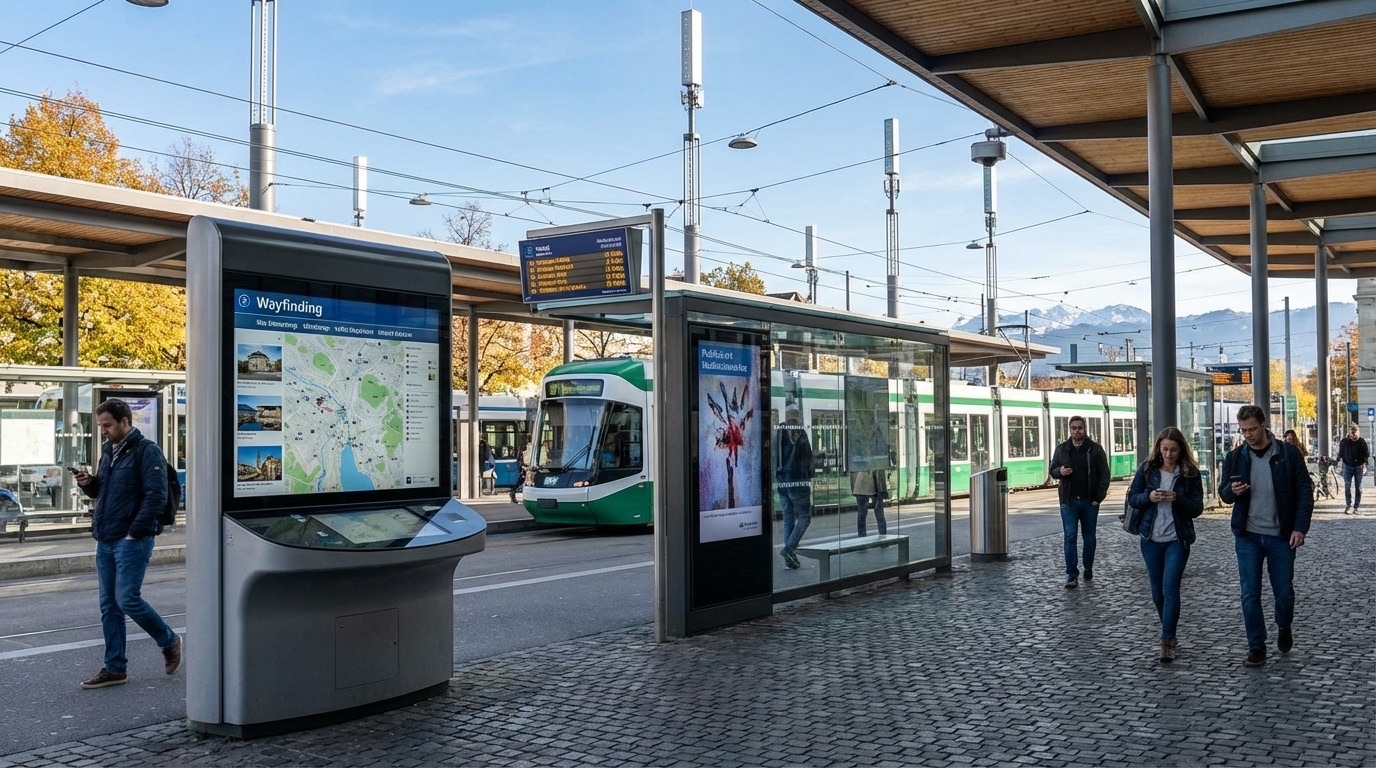
Swiss cities use Digital Signage networks to deliver contextual, location-specific information to residents and visitors. Connected to IoT sensors and municipal databases, these screens can display real-time public transport departures, parking availability, air quality indices, and community events.
Emergency communication infrastructure
The digital street screens installed in Olten and Solothurn in November 2025 show how Swiss municipalities can build emergency communication into Digital Signage. The 32 screens, installed by an outdoor advertising company, include an emergency function: in a crisis, the authorities can take over all the screens at once to alert the population.
In Olten, the town asked for its new screens in a special colour, so that they blend in with their surroundings, a sign of the attention Swiss municipalities pay to aesthetic integration alongside functional requirements.
Traffic management and wayfinding
Dynamic traffic and parking guidance signs are a long-established Smart City application in Swiss cities. LED signs connected to traffic sensors display real-time traffic information and parking availability to reduce congestion and improve urban mobility.
Linking Digital Signage with mobility data also makes wayfinding easier for drivers, cyclists, and pedestrians in complex urban environments.
Technology foundations: LoRaWAN and IoT integration
Many Swiss Smart City initiatives rely on LoRaWAN (Long Range Wide Area Network) technology as foundational infrastructure for IoT applications. In Zurich, ewz, the city’s electricity utility, operates a LoRa network covering the whole city, used for sensor applications such as smart parking.
St. Gallen’s “Smartnet” project, run by the city’s utility company, St.Galler Stadtwerke, showed in its pilot phase that LoRa technology provides reliable, cost-effective, and secure connectivity for Smart City applications.
The convergence of sensor networks, data analytics, and digital display technology creates opportunities for contextual public communication. Displays can automatically adjust content based on weather conditions, crowd density, air quality alerts, or transport disruptions, delivering relevant information when and where citizens need it.
The economic case for municipal Digital Signage
According to Grand View Research (June 2026 edition), the global Digital Signage market, valued at USD 31.1 billion in 2025, is expected to reach USD 58.4 billion by 2033, a compound annual growth rate (CAGR) of 8.2% from 2026 to 2033. For a municipality, street screens can serve two purposes: they carry advertising and provide a public communication channel.
The screens installed in Olten and Solothurn illustrate this dual use: the towns keep one third of the airtime for non-commercial content, such as cultural events, political information, and official announcements, and the rest carries advertising.
The two towns thus have a permanent channel for emergency alerts, civic information, and local news.
Digital Switzerland Strategy: policy framework
The Federal Council updates its Digital Switzerland Strategy every year. The 2025 edition, adopted in December 2024, set three focus topics: artificial intelligence, information security and cybersecurity, and open source. For Smart City Digital Signage, these priorities point to AI-powered content optimisation, secure network infrastructure, and interoperable municipal systems.
The 2026 edition, adopted on 12 December 2025, names three other focus topics: digital sovereignty and crisis resilience in the Federal Administration, Switzerland’s role as a digital host state, and the introduction of the e-ID. For Digital Signage deployments, the strategy as a whole translates into an emphasis on data protection, cybersecurity best practices, and integration with broader municipal digital ecosystems. For a municipality, resilience also means screens that can still inform the population in a crisis, as in Olten and Solothurn.
From our projects: measuring an audience without watching people
Municipal screens raise a question private retail can postpone: how do you know a public information display is reaching anyone, without turning a street into a surveillance zone? Our answer is architectural. On the jewellery windows documented in our case study on presence detection, the camera feed is analysed on the device to answer one binary question (is someone there?) and discarded immediately. Nothing recorded, nothing transmitted, nobody identified.
The same principle scales to audience measurement. In a design study for an international brand deploying temporary retail spaces, anonymous audience recognition was specified with all processing at the edge, on the player: no image stored or transmitted, only aggregate counters kept, no facial recognition, and no emotion detection. For a municipality, this is the first point to check: the installation records no image and identifies no one.
Implementation considerations for Swiss municipalities
Municipalities evaluating Digital Signage investments should consider several factors specific to the Swiss context:
Multilingual Requirements: Switzerland’s four national languages call for content management systems capable of delivering information in German, French, Italian, and Romansh, depending on the region.
Aesthetic Integration: Swiss communities place high value on visual harmony with historic and natural environments. Hardware specified for the site, such as the special colour Olten chose for its screens, helps digital infrastructure enhance rather than detract from urban character.
Climate Resilience: Swiss weather conditions ranging from Alpine cold to summer heat require displays rated for extreme temperature operation and appropriate brightness for varying daylight conditions, two criteria to check on any outdoor LED screen.
Accessibility: public information must also reach people with visual, hearing, or cognitive impairments, through features such as audio announcements, high-contrast displays, and simplified information presentation.