Many employees on production floors and in logistics have no company email address and no intranet access. Screens placed where they work and take their breaks reach them: this article explains where to install them, what to show, how to manage the content and how to calculate the return on investment.
On this page
Key takeaways
- Work units in the top engagement quartile show 23% higher profitability and 18% higher sales productivity than those in the bottom quartile (Gallup Q12 meta-analysis, 2024)
- Many deskless employees have no company email address and no intranet access
- Digital Signage reaches them where they work: multilingual, in real time, without adding to inbox overload
- ROI levers: reduced turnover costs, recovered work hours, training efficiency and consistent safety messaging
Why traditional internal communication falls short
According to Gallup’s global workplace research, only a minority of employees are actively engaged at work. Modern workplaces also struggle with fragmented communication: many deskless employees, on production floors or in logistics, have no company email address and no intranet access, creating significant information gaps. Meanwhile, employees who do receive emails often ignore them: the average office worker faces a daily flood of emails, making critical messages easy to miss.
Swiss companies face additional complexity with multilingual workforces spanning German, French, Italian, and English speakers. Traditional channels simply cannot deliver the real-time, visually engaging communication modern employees expect.
The business case for corporate Digital Signage
Primary sources give the following benchmarks:
- Work units in the top engagement quartile show 23% higher profitability and 18% higher sales productivity than those in the bottom quartile, with markedly lower turnover (Gallup Q12 meta-analysis, 2024)
- Replacing an employee can cost one-half to two times their annual salary (Gallup, 2019)
For Swiss corporations, these numbers translate directly to competitive advantage. Engaged employees deliver higher quality work, reduce turnover costs, and strengthen the company culture that attracts top talent. Screens alone do not create engagement, but they give every employee access to the same information.
Strategic placement for maximum impact
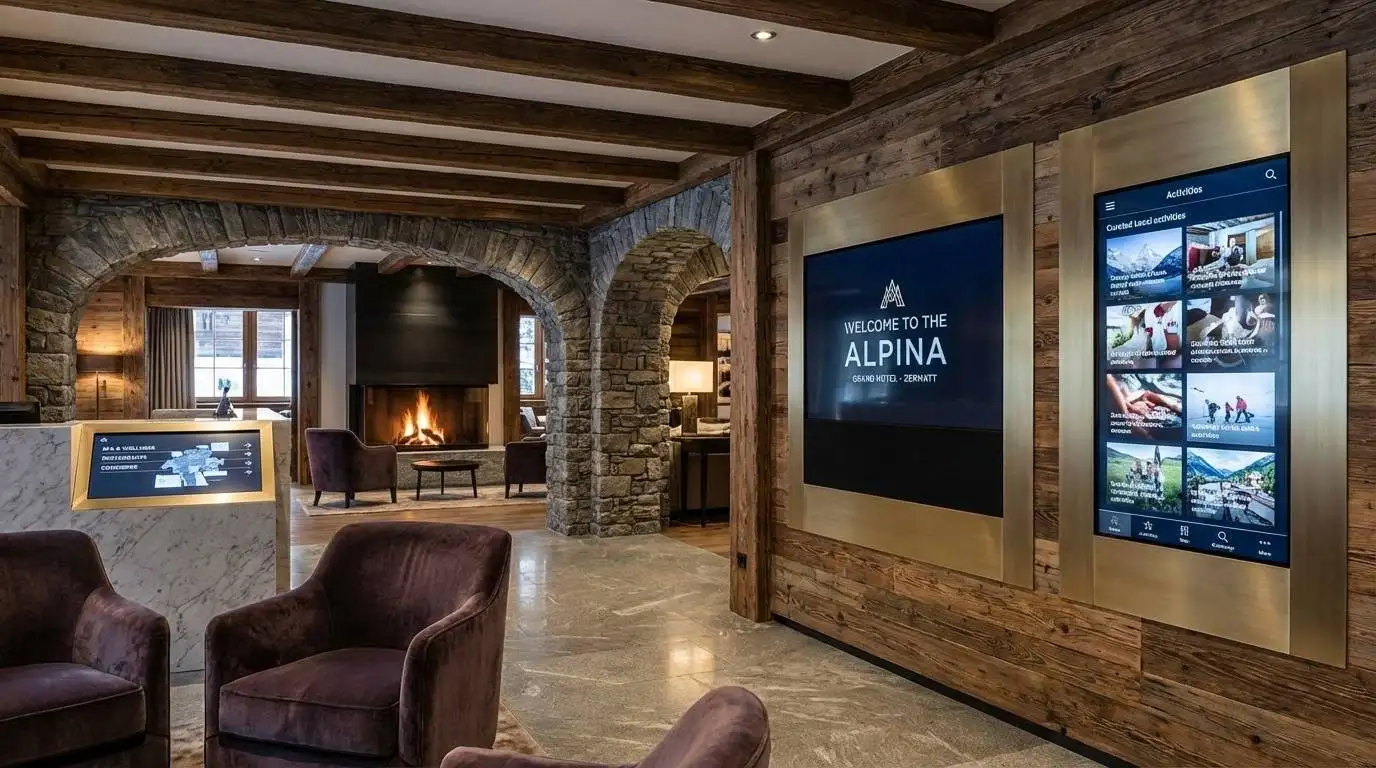
Reception and Lobby Areas: First impressions matter. Digital displays in entrance areas communicate company values, highlight achievements, and welcome visitors professionally. Swiss banks and corporate headquarters often use these displays to reinforce brand identity while providing real-time information to employees and guests alike.
Break Rooms and Cafeterias: Informal gathering spaces offer prime opportunities for engagement. Displaying team achievements, company news, and wellness information during break times reaches employees when they’re relaxed and receptive. Messages that combine a short text with images or video are easier to take in than text alone.
Production Floors and Operational Areas: Manufacturing and logistics companies, industries where Switzerland excels, benefit directly from Digital Signage. Safety reminders, production KPIs, and shift schedules displayed on strategically placed screens keep deskless workers informed without disrupting workflows.
Meeting Rooms and Collaboration Spaces: Room scheduling displays, video conferencing status, and resource availability information streamline operations while reducing the frustration of double-booked spaces.
Content strategies that drive engagement
Successful corporate Digital Signage requires more than impressive hardware. The content strategy determines actual engagement levels.
Employee Recognition: Highlighting individual and team accomplishments builds morale and reinforces desired behaviours. Precision, quality achievements and innovation milestones are natural subjects for Swiss companies.
Real-Time Performance Dashboards: KPIs, sales figures, and operational metrics displayed transparently help employees understand their contribution to company success. This visibility creates ownership and accountability across all levels. To see whether these screens are actually watched, DATAVSN anonymous audience recognition provides three metrics without identifying anyone: anonymous counting, stop rate and dwell time.
Multilingual Content Delivery: Swiss companies must communicate in multiple languages. A Digital Signage CMS lets you schedule each message in several languages or rotate language versions, ensuring every employee receives information in a language they understand.
Emergency Communication: Digital Signage can relay emergency alerts, evacuation procedures and safety notifications. Because all screens can be updated at once, everyone sees the same instructions at the same time. Screens complement the building’s alarm systems; they do not replace them.
Implementation best practices
Start with Clear Objectives: Define what engagement improvement looks like for your organisation. Whether reducing turnover, improving safety compliance, or strengthening culture, specific goals guide content strategy and measurement.
Choose Appropriate Technology: Corporate environments demand professional-grade displays capable of continuous operation. Consider brightness levels for various lighting conditions, screen size for viewing distances, and integration capabilities with existing systems. Understanding the Digital Signage software landscape helps ensure your choice scales with your organisation.
Develop Content Governance: Establish who creates content, approval workflows, and update schedules. Stale content undermines engagement: employees quickly learn to ignore displays showing outdated information.
Measure and Optimise: Track engagement metrics through employee surveys, content analytics, and behavioural observations. Use data to continuously refine what’s displayed and when.
ROI calculation framework
Swiss companies demand measurable returns. Calculate corporate Digital Signage ROI as (gains − costs) / costs, where costs cover screens, installation, software and content production (see our guide on how to calculate Digital Signage ROI). On the gains side, consider:
Reduced Turnover Costs: If Digital Signage contributes to retaining even a few employees annually, the savings can be substantial, since Gallup puts the cost of replacing an employee at one-half to two times their annual salary.
Productivity Improvements: Better internal communication translates directly into recovered work hours previously spent searching for information or clarifying misunderstandings.
Training Efficiency: Digital displays supporting onboarding and continuous training can reduce formal training hours while improving information retention.
Safety Incident Reduction: In manufacturing and industrial companies, consistent safety messaging helps prevent workplace incidents; comparing incident figures before and after installation shows the effect.
Future trends in corporate communication displays
AI-Powered Personalisation: Next-generation systems will deliver personalised content based on department, role, or even individual preferences, maximising relevance and engagement.
Interactive and Touch-Enabled Displays: Employees will increasingly interact with corporate signage, providing feedback, accessing detailed information, or completing quick surveys directly on displays.
Integration with Workplace Analytics: Digital Signage systems will connect with building management, HR platforms, and productivity tools to deliver contextually relevant information automatically.
Corporate Digital Signage with HYPERVISUAL
As a Swiss specialist in professional display solutions, HYPERVISUAL understands the requirements of corporate communication. From boardrooms to production floors, we design Digital Signage solutions for companies that keep every employee informed.