Indoor and outdoor LED screens differ in seven ways: brightness, protection against dust and water, pixel pitch, operating temperature, cooling, typical applications and cost of ownership. This guide explains each difference, covers the semi-outdoor and shop-window cases in between, and shows what to check before you choose.
On this page
Key takeaways
- Indoor LED screens typically run at 800–1’500 nits, with IP20 to IP54 protection and a pixel pitch of P0.9 to P5; outdoor screens run at 5’000–10’000 nits, IP65 to IP68, with a pixel pitch of P3.9 to P16.
- Outdoor screens cost significantly more, because of weatherproofing, high brightness and thermal management.
- Semi-outdoor locations need in-between specifications: at least IP54, 2’500–4’000 nits and a temperature tolerance of −10 °C to +50 °C.
- Rule of thumb: the minimum viewing distance in metres roughly equals the pixel pitch in millimetres (about 10 m for P10, 6 m for P6).
For context, Grand View Research (June 2026 edition) expects the global Digital Signage market, indoor and outdoor combined, to grow from USD 33.6 billion in 2026 to USD 58.4 billion in 2033, a compound annual growth rate (CAGR) of 8.2%.

Why indoor and outdoor LED screens differ
The difference between indoor and outdoor LED screens goes far beyond weatherproofing. The two categories are built for completely different environments, and the wrong choice leads to premature failure, poor visibility or unnecessary expense.
Indoor LED screens are optimised for close viewing distances, controlled lighting and aesthetic integration. Outdoor screens prioritise high brightness, resistance to the environment and long-range visibility.
1. Brightness
Brightness, measured in nits, is the most important difference between indoor and outdoor LED screens. Our guide to LED display brightness explains nits and lumens in detail.
Indoor LED brightness
Artificial lighting indoors typically provides 300–500 lux. Indoor LED screens work well at 800–1’500 nits, which gives excellent visibility without eye strain. More brightness in a controlled environment wastes energy and can even reduce viewing comfort.
Outdoor LED brightness
Direct sunlight can exceed 100’000 lux, so outdoor screens need far more brightness. Outdoor LED screens typically deliver 5’000–10’000 nits; the higher values keep content readable in the harshest conditions.
Brightness also degrades differently. An outdoor screen driven at full brightness runs hotter and, without proper thermal management, loses brightness faster over its life.
2. Protection against dust and water (IP rating)
The Ingress Protection (IP) rating indicates how well a screen resists dust and water, a critical specification for its lifespan.
Indoor ratings: IP20 to IP54
Indoor screens typically carry an IP20 rating (protection against solid objects larger than 12.5 mm only), or IP40 to IP54 where they may be exposed to occasional humidity. Without weatherproofing, they stay light and cost-effective.
Outdoor ratings: IP65 to IP68
Outdoor installations require at least IP65: the “6” means the enclosure is dust-tight, and the “5” means it is protected against water jets from any direction. Some outdoor screens go further, to IP67 (temporary immersion) or IP68 (continuous immersion).

3. Pixel pitch and viewing distance
Pixel pitch determines image sharpness and the optimal viewing distance of any LED screen; our technical guide to pixel pitch goes into more detail.
Indoor applications: P0.9 to P5
Indoors, viewers stand close, so the pitch has to be fine. Conference rooms and control centres use P0.9–P1.9 for viewing distances of 1–3 metres; retail environments typically use P2.5–P4 for 3–8 metres. A smaller pitch gives a sharper image but significantly increases the cost per square metre. HYPERVISUAL’s indoor LED screens range from P0.9 to P2.6, most often P1.8.
Outdoor applications: P3.9 to P16
Outdoor viewing distances of 10 to 100 metres and more allow a larger pixel pitch without visible loss of quality. Roadside billboards commonly use P10–P16, while installations aimed at pedestrians use P6–P8. Screens watched from a few metres, such as event screens, need a finer pitch: HYPERVISUAL rents LED screens for events in P3.9 for outdoor use; for permanent installations on façades, masts and open-air signage, see our outdoor LED screens. The rule of thumb stays the same: the minimum viewing distance in metres roughly equals the pixel pitch in millimetres.
4. Operating temperature
Temperature tolerance sets geographic and seasonal limits.
Indoor specifications
Indoor LED screens typically operate at ambient temperatures of 0 °C to 40 °C and rely on climate-controlled rooms.
Outdoor specifications
Outdoor screens must work across extreme ranges, from −40 °C to +70 °C for premium models. Thermal shock, the repeated swing between cold nights and sun-heated days, stresses the seals and is a common cause of water ingress.
5. Cooling and noise
Indoor screens usually rely on passive cooling (heatsinks and vents), which keeps the chassis at a moderate temperature and the screen very quiet.
Outdoor screens often need active cooling, usually fans, to prevent thermal degradation, which adds noise and maintenance.
6. Typical applications
Choose indoor LED screens for:
- Corporate lobbies and reception areas
- Conference rooms and boardrooms
- Retail stores and showrooms
- Exhibition halls and museums
- Control rooms and broadcast studios
- Hospitality venues and restaurants
Choose outdoor LED screens for:
- Building façades and architectural features
- Stadiums and sports venues
- Transport hubs (airports, stations)
- Roadside advertising billboards
- City-centre digital advertising
- Event stages and concerts
7. Cost of ownership
For both types, the total cost of ownership goes well beyond the purchase price.
Indoor LED screens
Indoor LED screens cost less to buy, need less maintenance and use less energy (see our guide to energy-efficient LED displays). A longer lifespan in a controlled environment also improves the return on investment.
Outdoor LED screens
The higher purchase cost of outdoor screens reflects their weatherproof construction and high-brightness components. Maintenance also costs more: weathering, repeated heating and cooling, and more frequent component replacement add up over the years. Outdoor projects can also involve permits and structural checks, which add to the budget.
The semi-outdoor case
Semi-outdoor environments (covered spaces partly exposed to the weather) present their own challenges. Shopping centre entrances, covered walkways and areas under canopies are exposed to indirect sunlight and temperature swings, but not to direct rain.
Standard indoor screens installed there lose brightness and fail early. These locations call for in-between specifications: at least IP54 protection, 2’500–4’000 nits and a temperature tolerance of −10 °C to +50 °C.
The hybrid case: a screen indoors, facing daylight
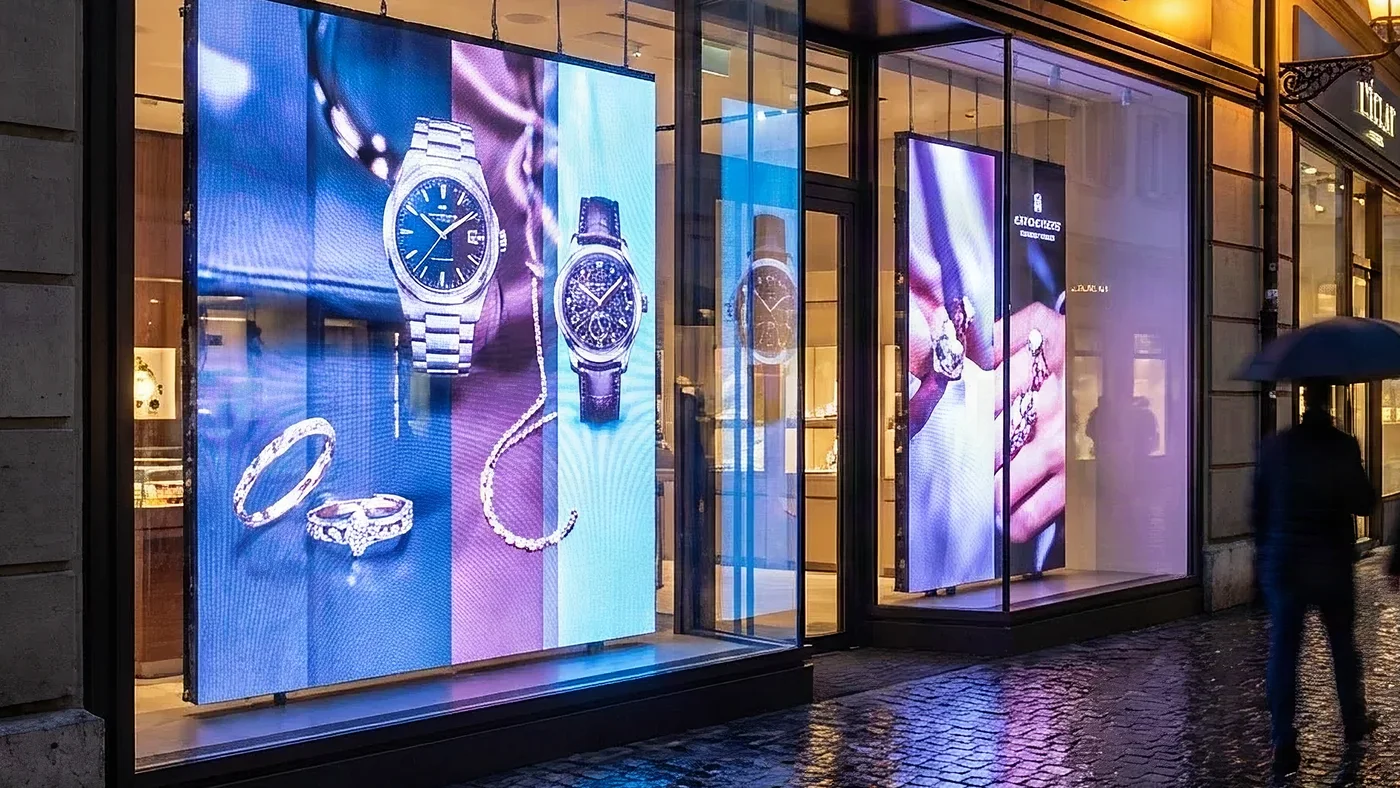
The indoor/outdoor split hides a third case that comes up constantly in retail: a screen installed inside, but fighting daylight through a shop window. It needs no weatherproof housing and no IP65 rating, yet consumer-grade indoor brightness leaves it washed out by mid-morning.
For a jeweller’s boutique network we equipped, that constraint set the specification: open frame LCD panels at 1’000 to 1’500 nits behind two-way mirrors, an indoor build several times brighter than a standard display. The trap in such a bay is thermal: behind glass, direct sun turns the recess into a greenhouse, so ventilation and service access have to be designed into the frame rather than added later. The build is documented in our case study on presence detection behind two-way mirrors.
Making the right decision
Choosing between indoor and outdoor LED screens means matching the specification to the environment, the viewing distance and the budget. Over-specifying wastes money; under-specifying leads to premature failure.
FAQ: indoor vs outdoor LED screens
Can I use an indoor LED screen in a covered outdoor area?
Generally not. Covered outdoor areas still see temperature swings, humidity and indirect sunlight, and an indoor screen without a suitable IP rating and enough brightness will fail early. Semi-outdoor installations need in-between specifications: at least IP54 and 2’500 nits or more.
Why is outdoor LED so much more expensive?
Outdoor LED screens need weatherproof enclosures (IP65 or higher), high-brightness LEDs (5’000–10’000 nits), thermal management and ruggedised components built for extreme temperatures (from −40 °C to +70 °C for premium models). These materials and design requirements substantially increase manufacturing costs.
How bright should my outdoor LED screen be?
For screens in direct sunlight, 6’000 nits or more are recommended; with only partial sun exposure, 4’000 to 6’000 nits are usually enough. Our guide to LED display brightness gives the full ranges by environment.
What pixel pitch should I choose for outdoor advertising?
It depends on the viewing distance: P6–P8 for pedestrian areas (viewed from 10–20 m), P10 for general outdoor advertising (20–50 m) and P16 for motorway billboards (50–100 m and more). As a rule of thumb, the minimum viewing distance in metres roughly equals the pixel pitch in millimetres.
How long do outdoor LED screens last?
Lifespan depends above all on thermal management, operating conditions and maintenance. Heat, humidity and repeated temperature cycles make outdoor screens age faster than indoor screens; regular maintenance and quality components extend their life significantly.